
The legend of Kalliyankattu Neeli – An interesting tale to read
Some decades and centuries ago, our attention shifts to a frightening night in a remote village of the erstwhile kingdom of Travancore, during a time when kings ruled the land. Roads were poorly developed, and the kingdom was far from advanced in transport, communication, and trade. Life still revolved around rural culture, with narrow pathways cutting through dense forests. In those days, travellers had to pass through thick forests either alone or in groups, and if they were delayed, they risked being stranded in lonely stretches of wilderness. More often than not, they were said to be greeted by thieves—or ghosts—or, at the very least, terrifying ghost stories.
Let us turn to one such eerie night, when a traveller was returning through the forest after a long journey. He walked along a narrow path, holding a flaming torch in his hand. Suddenly, the mesmerising fragrance of blossoming Pala flowers (the Devil Tree) filled the air, carried by a cool, chilling breeze. The traveller was drawn to the pleasant scent. In the dim moonlight, a large, traditionally built house appeared before him, and he thought, “I shall rest here for a while.”
But as he approached the building, the scene abruptly transformed into a tall palm tree. Slowly, the fragrance of the flowers grew stronger, and from nowhere appeared a beautiful young woman dressed in a white sari. Her long, untied hair danced freely in the breeze.
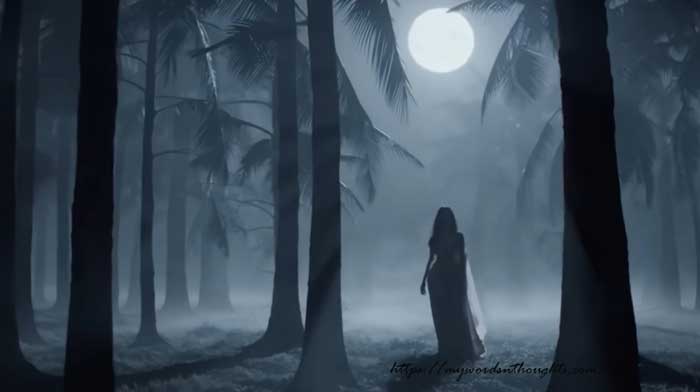
She smiled beautifully at him and then began to walk ahead. As if drawn by a magnet, he forgot everything and followed her in a trance. The next morning, his remains—mostly bones, nails, and hair—were found beneath the palm tree. Everything else had been devoured by that beautiful woman. According to legend, this is the fate of every man who falls into the trap of Kalliyankattu Neeli.
In the West, she is known as a vampire. In Hindi, she is called a Chudail. In Tamil, she is Pey, and in Malayalam, she is Yakshi. Essentially, they are the same entity, though they differ in cultural and geographical nuances. Every culture is associated with such eerie yet colourful tales, passed down from generation to generation—stories we often hear as grandmother’s tales.
This is the very same story repeated over centuries. More or less, identical versions have been passed down to successive generations. It is the same frightening tale of Yakshi that our grandparents heard during their childhood. It is the story of a betrayed woman who was killed by her husband in the same forest, and how she sought revenge. Her vengeance is often seen as justified, which is why she is portrayed as powerful.
Through this column, let us travel back in time and revisit the haunting tale of Kalliyankattu Neeli—the enchanting Yakshi. Also, read the heartwrenching story of Pootham & her bonding with Nangeli’s child, which lays the foundation of Poothappattu.
The Story of Kalliyankattu Neeli
Neeli’s real name was Alli
Like many other Yakshi tales, the story of Kalliyankattu Neeli also begins with a simple woman living an ordinary life. Before becoming a nocturnal hunter, she dreamed like any other woman. This story is believed to have taken place in the 9th century in the kingdom of Travancore, during the era of royal rule. In those days, Nagercoil—now part of the Kanyakumari district of Tamil Nadu—belonged to the southern tip of the Travancore kingdom.
Neeli was born as the daughter of Karveni, a devadasi, in the village of Pazhakkannur in Nagercoil. Her real name was Alli, not Neeli. From an early age, young Alli was known for her exceptional beauty. With thick locks of long hair and large, expressive eyes, she was admired by everyone. Legends describe her as a woman with a magnetic charm, and the local people often referred to her as a divine beauty.
She frequently visited a nearby Shiva temple, where she gradually became attracted to a young pujari named Nambi. He belonged to a higher-class family and enjoyed a good social status. Nambi, in turn, was drawn to the wealth of Alli’s family. Deeply in love, they eventually got married. Alli dreamed of a happy married life with Nambi, but soon cracks began to appear in their relationship. Nambi was neither virtuous nor faithful; he maintained illicit relationships with several women. His greedy eyes were also fixed on the immense wealth Alli had inherited from her family.
Alli’s mother grew angry at her avaricious son-in-law and was fully aware of his immoral behaviour. In those days, the Marumakkathayam system prevailed, under which the husband lived in the wife’s household with her parents. Alli’s mother asked Nambi to leave the house. Although her mother pleaded with her to stay, the pregnant Alli chose to leave with him. Such was her blind love for her husband. She believed that if they lived away from her mother for some time, her mother would eventually forgive Nambi, accept him again, and call them back home.
The couple started their journey on a Friday
It was on a Friday that Nambi and Alli started their journey to Nambi’s ancestral village. They travelled on foot, carrying their essential belongings, and passed through Kalliyankadu—the dense and isolated forest of Travancore. Alli was seven months pregnant, and it was the peak of summer. With no means of transport available in those days, Alli soon grew exhausted. She asked Nambi to rest for a while and found shade beneath a cactus plant. In Malayalam, a cactus is called kalli, and a forest filled with cactus plants came to be known as Kalliyankadu.
She rested her head on his lap, and, overcome by fatigue, soon fell asleep. At that moment, Nambi’s wicked thoughts began to take shape. His eyes fell upon the ornaments she was wearing and the money box she carried. Alli had brought along considerable wealth, hoping to rebuild her life with her husband in another place. Nambi began to fantasize about the financial gain and freedom he could enjoy in her absence. For a moment, he forgot the duties of a husband, and greed completely overpowered him.
In greed, Nambi turns into a murderer
In the isolated forest of Kalliyankadu, Nambi decided to kill his resting, pregnant wife. It was noon. Slowly, he shifted Alli’s head from his lap onto a stone and struck her with another stone, intending to kill her. She awoke in excruciating pain and, as she opened her eyes, saw her beloved husband standing over her like a monster, a stone clutched in his hand. In the final moments of her life, as she slipped toward death, she realized she had been betrayed by the person she loved the most. She screamed—not in pain, but to curse him—and called upon the nearby cactus plant to bear witness to this heinous act.
Though Nambi was shaken by what he had done, he felt no remorse. Without wasting time, he collected all her ornaments and money and left his wife’s lifeless body among the cactus plants. The forest fell silent once again; only the chirping of birds and the whispering of leaves in the wind could be heard. In those days, under royal rule, punishments were severe. Yet, with no eyewitness in the dense forest, Nambi believed he would escape punishment for the murder. What he did not realize was that unseen dark forces were beginning to awaken.
Kalliyankadu Yakshi was born in the deep forests
Innocent Alli transformed into a fierce Yakshi after her death. The loss of her unborn child made her even more powerful. Realizing Nambi’s evil intentions and the depth of his betrayal, she was consumed by rage. According to Kerala folklore and myths, Yakshis are born from unnatural deaths, and they often seek revenge. Alli remained in Kalliyankadu as a vengeful Yakshi, punishing those who had wronged her.
How did Alli get the name Neeli? There is no exact answer to this question. According to folklore, people who became familiar with her new behaviour gave her this new name. When someone travels through forests alone at night, fear hunts him. After death, Kalliyankattu Neeli took the form of a beautiful woman, started attracting stranded men in the forests at night and killed them. Neeli is described as a beautiful woman with an attractive body, long hair and a beautiful face. But she cleverly hid her monster face behind her killing smile, and she mostly targeted males.
One year later, Nambi travelled through that forest
Nambi almost forgot everything about Alli and began living a normal life—until everything turned upside down. One year later, while travelling through the same region, he reached a forest near the Sucheendram Temple. It was Friday noon—the very same day and time when he had murdered Alli in the deep woods a year earlier.
As he neared a large banyan tree at the edge of the forest, he saw a young woman carrying a child and softly singing a lullaby. She was extraordinarily beautiful and appeared like an Apsara (a celestial maiden) to Nambi. She smiled at him as though she knew him, and he was instantly captivated. Falling into a trance, he began to follow her. She turned back occasionally, guiding him deeper into the forest.
They soon reached an area filled with tall grass and slanted trees. There, Nambi noticed the same cactus plant that had witnessed his crime exactly one year earlier. To his horror, the sharp stones he had used as weapons were still scattered around, one of them bearing dark stains resembling dried blood.
Nambi’s heart began to race. A sense of isolation and dread engulfed him as the forest grew eerily silent. Fragments of memory surfaced, and the place began to feel hauntingly familiar. Yet, the beautiful woman allowed him no time to think. Still trapped in the magical illusion created by Neeli, he agreed when she asked him to rest. Exhausted from his long journey, Nambi sat beside her and placed his head on her lap. She sang softly, running her fingers through his hair, and soon he drifted into sleep.
Suddenly, the song stopped. In the next instant, she tightened her grip around his neck with immense force. Startled, Nambi opened his eyes—only to see not a beautiful woman, but a furious Yakshi trying to kill him. Kalliyankattu Neeli had revealed her most terrifying form. Bathed in blood and burning with rage, her eyes blazed with a thirst for vengeance. She appeared as she had at the time of her death—pregnant, blood-soaked, and furious. To Nambi, it felt as though Alli herself stood before him.
Neeli’s thunderous roar echoed through the forest, powerful enough to fell trees. Terrified, Nambi screamed and tried to escape. He ran, but his feet became trapped among the very stones that had once killed Alli. Neeli seized him and tore him apart in a fit of rage. She devoured him and drank his last drop of blood, finally finding peace.
Later, villagers passing through the forest found only his remains scattered among the cactus plants. Everyone understood that Neeli had finally taken her revenge. From that day onward, no one dared to pass through that forest again.
Neeli’s legend really started after her husband’s death
In most Yakshi tales, the spirit attains moksha, leaves the place, or becomes calm after taking revenge. However, Neeli’s story is different. Death transformed her into a bloodthirsty Yakshi. After tasting human blood, she craved it even more. She began wandering through Kalliyankadu—also known as Panchavankadu—and even ventured into nearby villages, spreading fear among the people.
Whenever she encountered men travelling alone through the forest, she lured them to isolated spots or palm trees and drained their blood. She primarily targeted men who succumbed to lust, using her supernatural powers to draw them into the valley of death.
Under the moonlight, travellers walking along forest paths would suddenly be mesmerized by the intense fragrance of jasmine or Devil Tree flowers. Soon after, they would hear the laughter of a young woman. She would then appear before them. At times, she trapped her victims by narrating tales of a tragic life; at other times, she invited them to rest at her home or share a meal. Sometimes, she appeared as a weeping woman seeking help. Thus, Neeli was feared not only as a blood-sucking vampire but also for her powerful magical abilities.
Magical powers of Kalliyankattu Neeli
Yakshis possess many magical powers, including the ability to create illusory worlds before their victims. Like other Yakshis, Neeli could conjure a grand mansion in the middle of the forest using her supernatural powers and make others believe it was real. Her prey would hallucinate, seeing lamps, lights, music, and dance, and unknowingly fall into her trap. By the next morning, the illusion would vanish, revealing that the victim was actually at the top of a palm tree—the Yakshi’s favourite hunting spot. The moment she attacked, she would transform from a beautiful woman into a terrifying demon. Once this transformation occurred, the chances of the victim’s survival were minimal.
Neeli was particularly drawn to men who succumbed to lust, including even brave warriors. Her husband was one of them, and his immoral behaviour had made her a victim. As a result, she harboured intense anger toward men of this nature. She would first identify her target, then use her magical powers to induce hallucinations, and finally lure him to a secluded place to kill him. She consumed everything except the hair, bones, and nails, and drank his blood as well. In rare cases, she devoured her victims entirely, leaving no trace behind. Unfortunately, in some unexplained disappearances caused by other reasons, villagers would often place the blame on Neeli.
During the Veda period, Indian Yakshis were totally different
In Buddha stories in the pre-Vedic period, Yakshis were depicted as good souls. They were symbols of prosperity, carriers of flowers and protectors of nature and villages. Their divine touch was named Dohatha. But as centuries passed, Yakshi’s representation also changed with the strong Brahmin dominance in Indian society. From protectors, they were changed to women with attractive powers, in interpretations and stories. The story of Neeli stands somewhere here. She is a true symbol of feminism in modern times, where she takes power by herself to punish those males who do injustice to her.
The story of Neeli spread like wildfire across Kerala
During evening gatherings under the soft glow of oil lamps, elders would share fantastical stories of Neeli. With every retelling, people added their own imaginations and assumptions to the few colourful facts they had heard. Everyone feared Neeli and dared not travel alone through forests. Some even claimed they had heard a woman’s laughter calling them from behind—but they never turned back. Truth or mere stories, who can say? Neeli’s name found a place in the traditional songs of Travancore and in Villadichanpaattu. Thus, she was kept alive by the people through poetry and music.
Neeli continued to live on through songs and tales passed down across generations. Such folklore forms an integral part of every culture. Gradually, her name entered literary works as well. The famous novel Marthanda Varma, published in 1891, mentions Neeli as a Raktarakshasi—a blood-drinking demon from whose clutches escape is impossible. In the lives of common people, her fearful presence was strongly felt, even if only through stories. Over time, people also developed new methods, rituals, and superstitions to protect themselves from Yakshis.
Iron was believed to offer protection against her, as evil spirits were thought to be powerless against this metal. Travellers passing through the Kalliyankadu forest would hide an iron knife on themselves so that Neeli could not touch them. Even today, many people hold on to this belief. Carrying a bundle of keys to ward off Yakshis is deeply rooted in the same idea. Scholars often used an Ezhuthani—an iron stylus used for writing on palm leaves—pierced through a lemon. They believed the combination of sour lemon and cold iron could drive away evil and negative forces. Since the stylus is associated with writing and education—symbols of enlightenment and the triumph of light over darkness—it was believed that this combination could overpower a Yakshi. In the folklore of northern Malabar, many such stories can be found.
Sankunni’s Aithihyamala, the iconic collection of Kerala folklore, contains numerous references to Yakshis. In Kerala’s popular culture, Neeli stands tall as a cultural mirror reflecting a bygone era. People fear her, yet love her too—because, from her perspective, she is right. Her story is that of a one-woman battle against injustice, reminding society of a woman’s basic rights. This is why Neeli and other Yakshis are worshipped in different forms across Kerala—in temples, sacred groves (kaavu), and even in ancestral homes as Yakshi Amma. Believers seek her blessings, and poojas are performed to please and calm her spirit.
Myths of Kadamattathu Kathanar
As per legends, Kadamattathu Kathanar, a Christian priest who had some supernatural powers, managed to overpower Neeli. Their battle has been retold in different ways by different people. Either she was nailed to a tree using his magical powers, or she was turned into a pure soul. It’s also possible he fully controlled her and turned her into a good spirit for the good of humans, as shown in Lokah: Chapter 1 movie.
Some stories say Neeli gave up her violent nature and decided to live peacefully under a Devil tree. In another tale, she was not destroyed but worshipped as a mother alongside goddess Parvati, often referred to as her sister. Though it’s paradoxical, she became a cultural icon and local goddess of worship. There is no authentic proof of her existence or spirit containment.
Yakshi and Chudail are more or less the same figures
 When a lady is seen alone in some mysterious situations, people observe her feet to ensure they touch the ground. If not, she is assumed to be a Yakshi. In some myths, which quite prevail in North Indian myths too, her backward feet indicate she is a Yakshi/Chudail. Only the name is different. In both cases, she is a female spirit or ghost — often described as the soul of a wronged or vengeful woman who died an unnatural or tragic death. She takes power into her hands to punish the wrong men. She lures them — especially young men, who are alone at night and kill only those who fall into her lust.
The only solution left is to run away from her without turning back. Also, keep an iron nail, knife, or keys to protect yourself. People often chant mantras and call God to rescue them, or carry holy books with them. You can find the same description of lady ghosts and similar figures in Western culture too. Only the names are different. Yes, in most stories, in a male-dominated world, Yakshi stands as a powerful woman who stands up for herself and all female victims, and punishes all those who wronged or did injustice to her.
In Neeli’s case, a few such escape stories do exist. According to myths, a young man escaped from the clutches of Neeli when he reached a temple pond. Evil spirits cannot enter places of worship, as per belief. In some stories, Neeli’s loud voice and laughter still echo in the deep woods of Kalliyankadu. It is only a part of her story.
Other alternatives to Neeli’s story
Though Alli’s story is most commonly believed, there are many other Neeli stories in Kerala folklore. Each writer/storyteller added their own creativity and imagination to make their own ‘Neeli’ story. In one alternative story, she is not Alli, who loved Nambi, but Neeli, who loved a person named Darshanam. When he disrespected and abandoned her, she started brutally killing villagers.
In another story, Allu and Ambi are siblings who are reborn as Neeli and Neelan, respectively, the children of a Chola king. The siblings were cruel right from childhood and grew up drinking the blood of cattle. So, they were abandoned at Panchavankaadu near Nagercoil, on the southern border of the Chola kingdom. In another tale, Ambi was given the name Anantharan in his rebirth. Neeli’s name remains the same, and the story is similar to the revenge tale of Kalliyankattu Neeli.
She is worshipped as a goddess in some South Indian temples
She is worshipped as a mother goddess in many temples, especially in southern Kerala. There are temples dedicated to Kalliyankattu Neeli, where she is worshipped. The most famous temple is in Nagercoil, Tamil Nadu, dedicated to the legendary figure. Devotees worship her as Neela Amma. Kalliyankattu forest is believed to be near this town. She is also worshipped as Yakshi Amma in Valya Panayannarkavu Temple in Parumala, Pathanamthitta district. While most Yakshis are believed to be wandering souls, she has been granted a sanctuary here.
In the Cherukunnam Sree Mutharamma Neeliyamma Temple of Kollam, she is worshipped as a Mother Goddess. Lemon lamps are lit for her during Rajasa pooja. Newly married couples visit her and offer silk and thali, praying to her for protection. It is a custom that has been followed for years. Not just in the case of Neeli, Yakshis are generally worshipped in temples across Kerala. They can take both good and bad forms, punish offenders, and bless devotees, too. Some Yakshis are believed to be divine.
She can transform into new forms in the future
In old times and classic-era movies, dramas, literary works, etc., she was always depicted as a beautiful woman clad in a white sari, standing beneath a devil tree. She may take different forms or transform into a fearful beast to scare or kill someone. Earlier, until a few decades back, a mother might call her daughter Neeli if she showed tantrums. In those days, she had no freedom to express her emotions or voice her opinions. She was always wronged by society if she opened her mouth. Neeli is often mentioned as an angry woman in a male-chauvinist world. The positive thing is that time is slowly changing, and more people are talking about women’s rights.

Kalyani Priyadarshan as Neeli of modern times
In modern times, she is often depicted as a superpower woman, protector and saviour, and even a superhero, representing a shift in how her story is interpreted. The best instance is her presentation in the 2025 Malayalam blockbuster Lokah: Chapter 1, where she appears as a modern woman, Chandra. She is presented as a soul wandering from one place to another, transforming herself into different forms. This can be called the evolution of the legend. Kalyani Priyadarshan’s role as Chandra became immensely popular among the masses, especially the new generation, who are not very familiar with the old sari-clad Neeli. Watch the movie trailer here.
In short, people have given their own versions to narrate the story of Neeli and placed her as a spirit or goddess fitting into cultural and religious boundaries, following certain customs and rituals. Kalliyankattu Neeli of the old Travancore kingdom is an integral part of Kerala culture and folklore. Many more generations will retell her stories with fear. She may take new faces and forms with time, but she is immortal and remains forever alive!
Also read about Kerala Culture, Tradition & Social Life. Visit my page.







Recent Comments