
The legend of Poothappattu
Similar to every art and poetic form, Poothappattu also has a story of its own. It follows a tradition closely linked to the social life of Kerala, especially the harvesting practices of the Ponnani region, and much more. It narrates a powerful story of motherhood and the bond between a child, Kunjunni, and his mother, Nangeli. The story is completed with the presence of a third character—a female ghost who has been denied motherhood.
Though it is folklore, the message it conveys is deeply touching. Yes, we may not seek justifications or factual truth behind this story.
Though the Malayalam word ‘Pootham’ or ‘Bhootham’ means ghost, it also carries an inner meaning—“something pure.” Let us explore how Pootham is considered sacred and pure.
The story of Pootham and Nangeli

Poothappattu means ‘Song of the ghost/spirit’, and there is a folklore connecting a good spirit, a mother and her child, which deeply touches everyone’s heart.
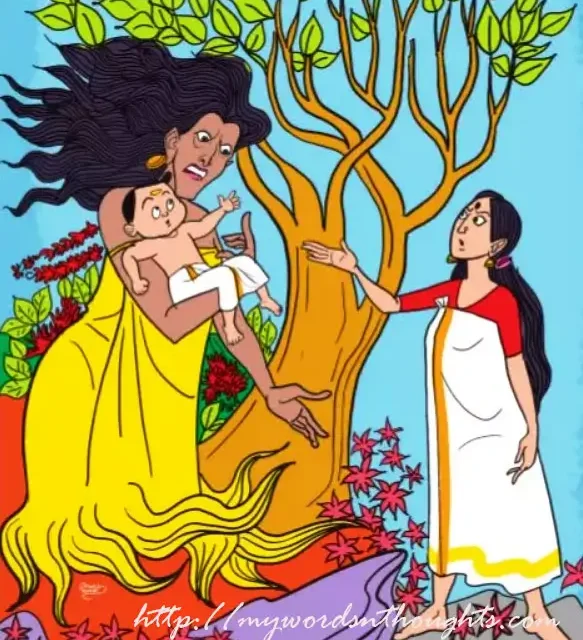
There was a female devil (Pootham) who lived behind the rocks of Parayan Kunnu, a hill. She spent her daytime peeping through the gaps in the rocks. When shepherds grazed cows in the nearby areas, she secretly drank milk from the lonely ones, hiding from everyone. It was her habit to mislead people when they were on their way to relatives’ homes in the late evening. She would often demand a betel box (a pan box containing betel leaves and other ingredients). She chewed the pan and spat it out in red colour. Folklore says this is why ixora flowers are blood red.
On lonely nights, she loosened her hair and stood by the roadside, laughing aloud. When a man passed through the place in the late evening, she would misguide and lure him, leading him towards nearby palm trees. Through magic, she created the illusion that the tops of the palm trees were seven-storied buildings. Once she reached the top of the tree, she revealed her true nature. She killed the men, drank their blood, and consumed their flesh, leaving behind only hair and bones.
This was the story of her earlier days. She has changed a lot now. Pootham is no longer cruel, nor does she possess such evil habits. She is now calm, but lives in deep grief over not having a child. Also read: The legend of Kalliyankattu Neeli, a Yakshi who shares a similar story.
Nangeli Amma was blessed with a child after many prayers. She pampered him and looked after him with great care. Unni, the child, was now seven years old, and his mother decided to send him to school for Ezhuthiniruthu (the ceremonial beginning of studies). She gave him palm leaves and a Narayam (a writing instrument similar to a pen), and Unni set out on his first journey to school. He wore a Kerala dhoti, and his mother watched him until he disappeared from her sight. Unni enjoyed the sights around him as he walked towards his school.
Pootham happened to see Unni through the ‘windows’ while she was peeping through the rocks. A strong desire for the child arose within her, and the motherly instinct awakened in her heart. She transformed herself into a young girl and stood in his path. She promised him that if he were willing to throw away his ezhuthani and palm leaves in the nearby forest and follow her, she would teach him how to write with jasmine flowers on the tender leaves of a mango tree, sitting beneath its shade and enjoying the cool breeze. Unni believed the ‘girl’s’ words, threw away his palm leaves and pen, and followed the ghost.
Unni did not return home by evening, and his mother grew anxious. She went out searching for her child, calling out his name. At last, she found them beneath a flowering tree. Unni was in a cheerful mood, happily playing with Pootham. They were making flower garlands under the tree. Pootham tried to frighten Nangeli so that she would leave the place, but Nangeli refused to accept defeat. Pootham then tried to lure her with expensive gifts, but Nangeli did not give in. She pierced her own eyes and offered them to Pootham, saying that her child was more precious to her than her sight.
Pootham then attempted to deceive her. She created a replica of Unni using the stem of an ixora plant and handed it over to Nangeli, who was now blind. However, the mother immediately realized that the child had no fragrance of her breast milk and therefore could not be hers. When Nangeli was about to curse the ghost, Pootham returned her real child.
Pootham was given a blessing
Nangeli, too, was moved by Pootham’s motherly love and blessed her. She allowed Pootham to visit the child after the paddy fields had completely dried following Makarakkoythu (the harvesting of rice during the Malayalam month of Makaram, which falls in February–March). According to popular belief, Pootham visits the region every Makaram season after the harvest. Yet, she continues to search for the home in which Unni was born. Truly, it is a heart-wrenching story.
This is one of the most popular poems written by Edasseri Govindan Nair, that is connected to Poothappattu. The poem captures the heartbeat of Ponnani and is loved and cherished by all Malayalis who carry a villager’s soul within them. As the story goes, when Pootham searches for Unni in every household, children accompany her without fear. It is also believed that after the Makaram harvest season in the Valluvanadu regions of Kerala, the spirit visits each home, playing her musical instruments (thudikottu and kuzhal vili). She also wears an anklet filled with bells (chilambu), creating a resounding rhythm as she walks.
Edasseri Govindan Nair & his masterpiece work
Yakshiyum Poothavum (Poothapaattu)
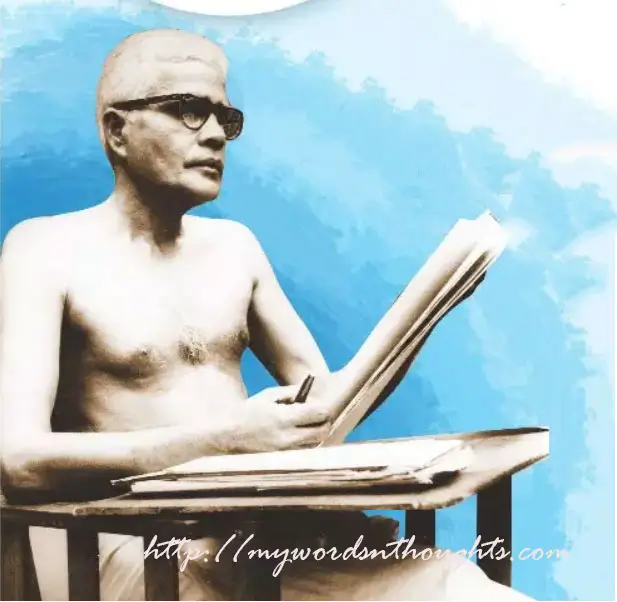
Yakshiyum Poothavum is not just a piece of poetry, but a poem with a full-length narrative—a vivid visualization of Edasseri Govindan Nair’s poetic work Poothappattu. Based on this story, a dance form or ballet called Poothappattu was created. With a strong folk touch, it is performed in the Valluvanadu regions of Kerala. This folk tale has been passed down from one generation to the next and continues to be followed as a living tradition.
Such stories are powerful enough to create fantasy in the human mind and shape one’s imagination. Yakshi, Pootham, Marutha, Odiyan, Ottamulachi—there are numerous folklore figures deeply rooted in the cultural and village life of the people of Kerala. However, very often, such ghost stories are also used to instil fear in others.
Edasseri Govindan Nair was born into a poor Hindu family and experienced poverty during his early years. He lost his father at a young age and had to discontinue his studies at the age of 15. Yet, his mother dreamed of educating young Edasseri and wished to send him to high school. Unfortunately, the family’s financial condition did not permit this, and Edasseri decided to take up odd jobs to support his impoverished family.
To learn accounting, he moved from his hometown to Alappuzha. As he set out on this journey, his mind was filled with the trembling image of his mother, who was already ill. He carried an intense desire to buy a woollen cloth for her.
After two months of hardship, he managed to earn two rupees—a considerable sum in those days, sufficient to buy a woollen cloth. He sent the cloth through a person from Kuttippuram. However, before the gift reached her, his mother passed away. This incident deeply shocked the teen Edasseri, and later, he poured his grief and profound love for his mother into many of his poems. He wrote:
“Avalkk Kulirinu Kambili Thedi-
Ppinneedenno Njaan Chelke
Oratti Mannu Puthachu Kidappoo
Veedaakkadame Mama Janmam.”
Who else can arrange such a folk tale on motherhood into a beautiful symphony, except Edasseri! Yes, he knew the true meaning of motherhood and the bonding between a mother and her child.
Also visit my page: Kerala culture, traditions and social life.









Recent Comments