
Ustad Faiyaz Khan is universally considered the absolute No. 1 artist and supreme exponent of the Agra Gharana, the school founded centuries earlier by Haji Sujan Khan (who was part of Tansen’s extended musical circle). He was also called Aftab-E-Mausiqi, which means ‘The Sun’ or ‘Sunshine of Music’. This title was awarded by the Maharaja of Mysore in 1908. He lived during the period, 8 February 1886 – 5 November 1950. He was the most influential Hindustani vocalist of the century.
Ustad Faiyaz Khan – The Greatest Hindustani Vocalist Belonging to Agra Gharana
He received formal training from different schools of music
He was born at Sikandara, near Agra, in the North-Western Provinces during British rule. His father, Safdar Hussain, died four months before his birth. He was brought up by his maternal grandfather, Ghulam Abbas Khan, who trained him in Dhrupad till he reached 25. He received training in Dhamar from his grand uncle, Ustad Kallan Khan, the younger brother of Ghulam Abbas Khan. Both were leading musicians of the Rangila gharana in the second half of the 19th century.
He also learnt Hindustani music from Ustad Mehboob Khan “Daraspiya”, his father-in-law, Natyan Khan, and his uncle Fida Hussain Khan.
A sacred pilgrimage laid basement to his singing career
While Faiyaz was still a teenager, his grandfather took him on a massive tour of all the major musical hubs of India. He aimed to make young Faiyaz listen to different singers and different genres of music. Thus, Faiyaz was exposed to every reigning contemporary titan of the late 19th century, which helped him a lot throughout his professional journey.
The Breakthrough: The 1904 Bombay Concert
By the age of 18, Faiyaz was already known within inner musical circles. He started earning praises for the incredibly polished and technically sound voice.
When he was only 24, he was to perform at a Bombay concert. The reigning master Miyanjan Khan (a celebrated disciple of the Patiala Gharana) gave a brilliant, show-stopping recital of Raag Multani. Young Faiyaz Khan was scheduled to perform immediately after him. It was a terrifying slot for a young artist back then.
Young Faiyaz reproduced Miyanjan Khan’s complex style and phrases flawlessly, surprising everyone. Miyanjan Khan embraced him and exclaimed publicly: “Tum hi ustad ho!” It was a moment when his talent was truly appreciated. At this point of time, a real legend was born.
His musical journey later
In 1908, a competition was arranged at the Mysore Durbar by the Maharaja of Mysore between Faiyaz Khan and the court champion, Ustad Hafiz Khan. But Maharaja couldn’t pick up the winner, as both performed extremely well. The ecstatic Maharaja conferred upon Faiyaz Khan the supreme historic title: “Aftab-e-Mausiqi”, a title he carried throughout his life.
In 1912, after watching his performance, Maharaja Sayajirao Gaekwad III of Baroda appointed him as the principal Court Musician of Baroda State, and Baroda became Faiyaz Khan’s permanent home. During his skyrocketing times of fame, a face-off concert was arranged with leading vocalist Pandit Bhaskar Bhuwa Bhakle. Upon hearing Faiyaz Khan’s thunderous voice, Bhakle publicly refused to compete, declaring Faiyaz his “brother” in music.
He was a celebrated performer at AIR, and his voice reached even remote villages during the early days of independent India. Though Ustad didn’t have a family and died childless, he left a legacy for many generations to follow. His disciples include music legends like Khadim Hussain Khan, Vilayat Hussain Khan, Sharafat Hussain Khan, Pt. S.N. Ratanjankar, Jnanendra Prasad Goswamy, Asad Ali Khan (later migrated to Pakistan), and Dhruvatara Joshi.
Read about Indian Musician, Asad Ali Khan – Rudra Veena Artist (not to be confused with Faiyaz Khan’s student)
Ustad Faiyaz Khan – 10 Interesting and Lesser-known Facts
1. Faiyaz Khan’s musical lineage goes back to the Great Tansen (1493 – 1589) himself. His family is traced back to Alakhdas, Malukdas, and then to Haji Sujan Khan (son of Alakhdas, who became a Muslim).
2. He lost his wife soon after marriage, and never married again. He died childless, and hence didn’t have any heir to carry forward his legacy.
3. For his live performances in concerts, he was fondly called Mehfil Ka Badshah. He was frequent in music circles of Lucknow, Allahabad, Calcutta, Gwalior, Bombay, and Mysore.
4. Ustad Faiyaz Khan specialised in both dhrupad and khyal, but was also well-versed in thumri and ghazal.
5. Rabindranath Tagore was an admirer of Ustad Faiyaz Khan. Khan also performed at Jorasanko Thakurbari, the residential abode of Tagore. In fact, almost all his contemporaries and legends of music were his great admirers.
6. Bollywood playback singer, K. L. Saigal, was his disciple.
7. He composed several bandishes using the pen name ‘Prem Piya’. His thumri, Baaju band khul khul jaye, is still extremely popular.
8. He collaborated with musicologist Pandit V.N. Bhatkhande to document and preserve ancient bandishes.
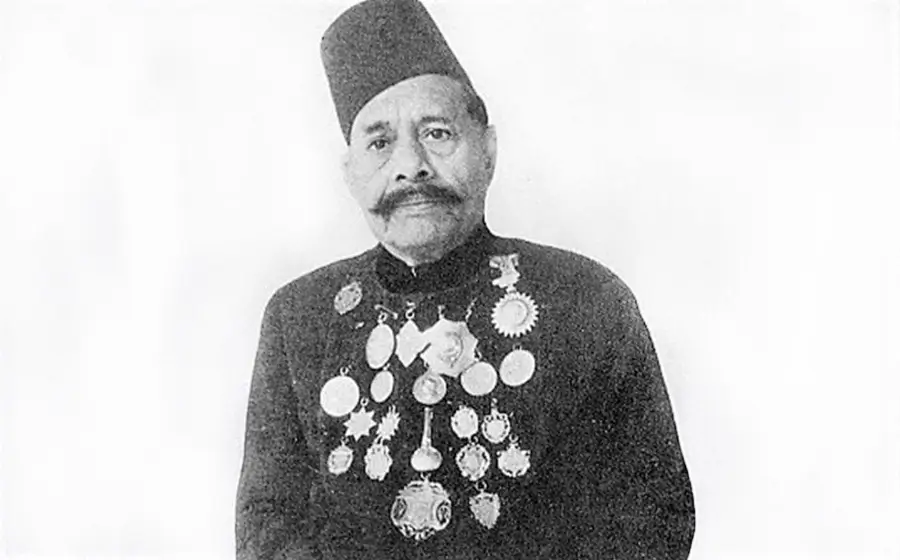
9. When he served as the Court Musician of Baroda State, he received a massive salary, a grand house, and was treated as a top-tier state dignitary. He used to walk through the streets of Baroda with a silver-handled walking stick and wearing gold medals awarded by various kings.
10. During his prime, Ustad Faiyaz Khan always sang in C Sharp and C scale. In 1945, he contracted tuberculosis, which affected his voice. He was affected by a bout of typhoid, after which he lowered his pitch to B and B Flat. Unfortunately, most of his available recordings belong to his later years. After 5 years, he succumbed to TB.
Also read the biography of Sumati Mutatkar, a female performer of Agra Gharana.







Recent Comments