
Ustad Asad Ali Khan was a Rudra Veena exponent who lived during the period, 1 December 1937 – 14 June 2011. He played the stringed instrument in Dhrupad style and was one of the best Rudra Veena artists of the country. Khan was a recipient of numerous honours and recognitions. He received the Indian civilian honour, Padma Bhushan, in 2008. He belonged to the seventh generation of Rudra Veena players in his family, which includes great artists like Rajab Ali Khan.
Ustad Asad Ali Khan: The Legendary Rudra Veena Maestro
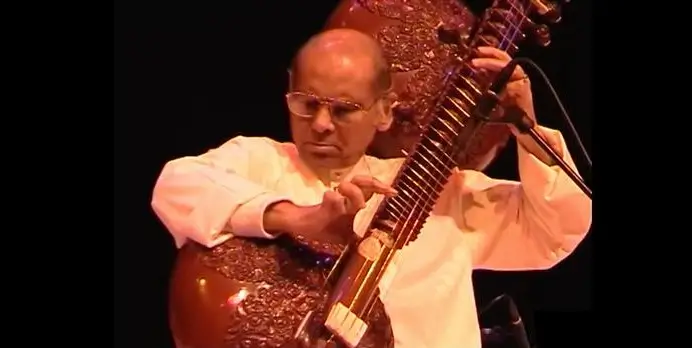
Khan was born on 1st December 1937 in Alwar (present-day Rajasthan) into a family with a strong influence on musical traditions. His family was traditionally associated with the string instrument, Rudra Veena, for 7 long generations by then. His great-grandfather, Rajab Ali Khan, was head of the court musicians in Jaipur.
Seven generations of musical legacy
Many of his ancestors were royal musicians in the courts of north India in the 18th century and later. Hence, the family owned an elite position in society and was traditionally rich. His forefather, Rajab Ali Khan, owned a village land holding. He was one of the prominent figures associated with Rudra Veena. His grandfather, Musharraf Khan and father, Sadiq Ali Khan, also served as court musicians in Jaipur.
Khan grew up listening to music. He formally took lessons in Rudra Veena in the Beenkar gharana style of Jaipur, alongside vocal lessons. After learning music for a long 15 years, he started teaching disciples, and has several reputed students, who established themselves. He was the last surviving master of one of the four schools of dhrupad, the Khandar school of music. Also, he was one of the rare artists who played the Rudra Veena among his contemporaries (historically called the Been).
Ustad Asad Ali Khan worked at All India Radio, taught the sitar at the University of Delhi for 17 years and also gave private musical lessons to children till his death. Khan died on 14th June 2011 in Delhi, aged 74. He was unmarried and adopted his nephew Zaki Haidar as his son. Madhumita Ray, Carsten Wick from Germany, Dr. Keshav Sharma and Bikramjeet Das are among his major disciples.
Ustad Asad Ali Khan believed that the Rudra Veena was created by Lord Shiva himself. He openly criticised the lack of willingness among Indians to study the rudra veena, compared to foreign students. The most widely active lineage of Rudra Veena players today belongs to the Dagarvani style. Unfortunately, he was the last artist who fully followed the rules of Khandar Dhrupad, in vocals and instrumental combined.
The 7-Generation Rudra Veena Lineage
Shahaji Saheb (18th Century) was the founding ancestor, who established this specific family line of Beenkars in Rajasthan. There is no historical data about the next two generations of musicians, except that they carried forward the legacy. The only data available is that the third-generation member was a court musician in Rajasthan.
Ustad Rajab Ali Khan (The 19th-Century Beenkar) represented the 4th generation member of the family tree. He was the legendary great-grandfather of Asad Ali Khan, who served as the highly revered head of court musicians in Jaipur. Ustad Musharraf Khan (Died 1909) was the next generation member. Khan’s grandfather was an illustrious court musician in Alwar, who famously played the Rudra Veena in London in 1886.
His father, Ustad Sadiq Ali Khan (Died 1964) represented the 6th generation of Rudra Veena artists from his family. He served the Alwar and Rampur royal courts for 35 years. He also gave rigorous training to Asad Ali Khan for 15 years, who later represented the 7th generation. As Ustad Asad Ali Khan was unmarried and childless, he adopted his nephew Zaki Haidar as his son. Zaki Haidar continues to perform and teach today as the 8th generation of this incredible line.
A brief note on the four schools of Dhrupad
Dhrupad is the oldest surviving form of Hindustani classical music. It has a long-term association with Mughal Emperors and their court musicians. During Akbar’s rule, Dhrupad split into four distinct stylistic schools, historically called Banis (or Vanis). Each school was founded by a legendary court musician and has its own set of rules.
Gauhar Bani, founded by Mian Tansen, owns smooth, slow, and peaceful note transitions (meends). Dagar Bani, founded by Braj Chand, emphasises absolute structural purity, simple elegance, and meditative alaps. It is the most widely surviving vocal school today.
Nauhar Bani, founded by Rajput Sri Chand, has quick, surprising, and jerky musical phrases, while Khandar Bani (The Khandar School), founded by Raja Samokhan Singh of Khandar, is majestic, heavy, robust, and highly ornamental. It relies heavily on complex, powerful vocal gymnastics called gamaks. When played on an instrument, it demands incredible speed, power, and flawless physical precision.
Ustad Asad Ali Khan was the “last surviving master” of this school. He was the final musician who held the complete, unadulterated generational knowledge of the Khandar school of music. While the style and techniques of the Khandar Bani are absolutely alive and being performed by brilliant vocalists and instrumentalists, they are no longer practised in complete isolation. In short, no one sings purely Khandar anymore!
The same is the fate of Rudra Veena too. The structural lineage of pure, unmixed Khandar Bani ended with historical giants like Ustad Asad Ali Khan. Yet some of its elements have survived as a hybrid element within modern Dhrupad gharanas like Darbhanga and contemporary Rudra Veena playing.
Also read: Naubat Khan – 16th-century artist of the Rudra Veena, who played in Akbar’s court.





Recent Comments