
Nilmani Phookan, often addressed as Nilmani Phookan Senior, was a great Assamese writer, freedom fighter, and politician who lived during 22 June 1880 – 20 January 1978. He was popularly known as Bagmibor (Master Orator) in the Assamese literature. He served as the president of the Asam Sahitya Sabha twice, during 1944 and 1947, and is known for his anti-Bengali utterances and crusade against its use in Assam.
Nilmani Phookan (Senior) – Assamese Writer and Freedom Fighter in the Pre-Independent Era
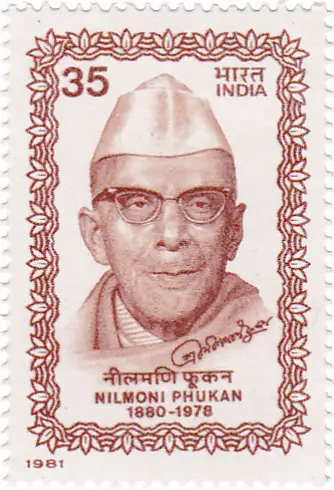
Nilmoni Phukan was born on 22 June 1880 at Dibrugarh district, Assam, British India. His father’s name is Lombodhar Phukan. He did early schooling from George’s Institution, Dibrugarh, followed by Cotton College, Guwahati, and a Bachelor of Arts from Victoria College at Cooch Bihar in 1907. Though he pursued law studies, he left it incomplete to dive into social reform and regional activism.
His name is always taken as Nilmani Phookan “Senior” and this is done to distinguish him from his namesake, Nilmani Phookan (Junior), who was a famous Assamese poet and academician.
The “Bagmibor” – Master Orator from Assam
He had an astonishing command over language and public speaking, and hence he was often addressed as “Bagmibor” in the Assamese language. He motivated Indians through his speeches, as a part of the freedom struggle movement, and also the regional social assemblies. Through his speeches, Nilmani Phookan also made the public aware of the protection and preservation of the Assamese language against colonial administrative neglect.
He was elected President of the Asam Sahitya Sabha twice during 1944: The Sivasagar Session and 1947: The Dibrugarh Session (occurring during the historic year of India’s independence). A commemorative postage stamp has been created in his name.
His contributions to journalism and literature
He was a pioneering voice in early regional journalism. He served as the editor of Dainik Batori, a highly influential daily newspaper of its time. He, along with noted tea planter and philanthropist Sivaprasad Barua, managed it.
His writing was deeply philosophical, reflective, and patriotic. His major works are Jyotikona(1938), Sahiityakola (1940), Joya Tirtho(1941), Chintamoni (1942), Manashi (1943), Gutimali (1950), Jinjiri (1951), Mahapurusiya Dharma(1952), Omitra (1952), Xondhani (1953), Xotodhara (1962), and Mormobani 1963).






Recent Comments