
Pandit Kishan Maharaj was a famous tabla player belonging to the Banaras gharana of Hindustani classical music. For his immense contributions to Indian art and music, the Government of India honoured him with the Padma Shri in 1973 and the Padma Vibhushan in 2002. His name is always taken alongside the greatest Indian artists of the 20th century. Maharaj is arguably the most globally recognised, celebrated doyen of the Banaras Gharana.
Apart from accompanying doyens of Hindustani music of the 20th century in several concerts, he has also given outstanding solo performances. He has also participated in many international concerts like Edinburgh Festival and the Commonwealth Arts Festival in the United Kingdom in 1965.
Know More About Kishan Maharaj – Legendary Indian Musician
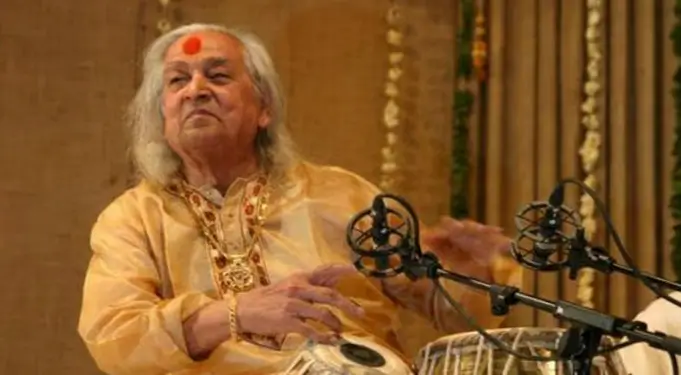
Kishan Maharaj was born into a Brahmin family in Kabir Chaura, Benaras, on September 3, 1923. His family had a strong musical background. Hari Maharaj and Anjora Devi were his parents. He was adopted by his paternal uncle Kanthe Maharaj, who was childless.
Kishan received initial training in tabla from his father. He lost his father at the age of 6. After his death, the training was continued under Kanthe Maharaj, who was his father’s elder brother. The family traditionally followed the Banaras school of music. Under his uncle’s fiercely strict tutelage, Kishan practised for over five to six hours a day, mastering the complex Purbi baj (the open, resonant playing style specific to Banaras).
Kishan Maharaj was married to Savita Devi, daughter of Siddheshwari Devi, a very famous Hindustani vocalist from Varanasi. She is the niece of the Tabla maestro of the Benaras Gharana, Pandit Anokhe Lal Mishra.
He accompanied many great vocalists of the time, like Bhimsen Joshi and Ravi Shankar
Kishan started accompanying artists at the age of 11. Over the years, he was fortunate enough to accompany some of the great Hindustani musicians of the 20th century. Those great names include Bhimsen Joshi, Ravi Shankar, Faiyaz Khan, Omkarnath Thakur, Bade Ghulam Ali Khan, Ali Akbar Khan, Vilayat Khan, Girija Devi and Sitara Devi.
He also got the opportunity to perform with celebrated tabla maestros like Samta Prasad, Alla Rakha, and Karamatullah Khan. No wonder he became an essential stage companion for every single giant of 20th-century Indian Hindustani classical music.
He played cross-rhythms and complex calculations, particularly in tihai patterns
He was versatile in playing tabla with any accompaniment. His unique quality was to play cross-rhythms and complex calculations, particularly in tihai patterns. His “Tala Vadya Kacheri” with the Mridangam Vidwan, “Palghat Raghu”, is remembered as his outstanding performance.
As Banaras Gharana is fundamentally intertwined with Indian classical dance, he was successful with several Kathak exponents. He gave `Sangat` to legendary classical dancers like Sri Shambhu Maharaj, Sitara Devi, Natraj Gopi Krishna, and Birju Maharaj.
Kishan Maharaj also had many gifted disciples. Sukhwinder Singh Namdhari, Pandit Nandan Mehta, Sandeep Das, Himanshu Mahant, Balkrishna Iyer, Pandit Kumar Bose, Pandit Balkrishna Mahant, Arivind Kumar “azad” Vineet Vyas, and Shubh Maharaj are among those disciples.
He passed away on 4 May 2008 in his hometown. His son, Pandit Pooran Maharaj, and his grandson, Shubh Maharaj, follow his legacy.
Kishan Maharaj – Some interesting and lesser-known facts
1. He was born on the auspicious day of Krishna Janmashtami.
2. He had a brief career in the film industry. He moved to Bombay in 1944 to pursue a music career, but faced a lot of struggles. Later he concentrated to music concerts, and earned fame and popularity.
3. He provided tabla accompaniment to Sitara Devi in the Hindi film Badi Maa (1945).
4. He was so versatile that he was capable of playing with most accompaniment, be it with the Sitar, Sarod, Dhrupad, Dhamar or even dance.
5. Kishan Maharaj always performed, sitting upright with a large red tilak on his forehead, as his signature style, radiating immense authority.
6. He was a contemporary of the great tabla artist, Samta Prasad. Born just two years apart in the historic lanes of Kabir Chaura, Pandit Samta Prasad and Pandit Kishan Maharaj grew up as close gharana brothers, balancing a fierce professional rivalry on stage with deep familial affection off stage.
7. He was celebrated as a mathematical genius, for his mastery over cross-rhythms and unbelievably complex calculations, particularly his execution of the tihai pattern.
8. He received the Sangeet Natak Akademi Award in 1984, and was selected as a Fellow of the Sangeet Natak Akademi (the highest national recognition for lifetime contribution to performing arts) in 2006, apart from 2 Padma awards.





Recent Comments