
Have you ever tasted Karakka?
Ever tasted karakka preserved in brine inside glass jars in local shops during your childhood days? Or have you listened to the nostalgic stories of students eagerly waiting for the lunch break just to buy karakka from the small shops near their schools? Have you ever experienced it in your childhood? Yes, I have. Yes, Karakka has a nostalgic treat, sharing a lot of childhood memories.Kerala village life has many such unique things to share to outer world.
This fruit has a uniquely sharp and addictive taste. A little sweetness and predominantly sour, Karakka is unique. Its salted version of unripe ones is kids’ favourite always. It is a fruit tree found in some rural parts of Kerala, especially in southern districts like Thiruvananthapuram. Its origin is Sri Lanka, and because of its resemblance to olives, Karakka is also known as Ceylon Olive.
You can easily grow Ceylon Olives (Karakka) in your garden or farm

If you don’t have enough space, you can even grow it easily on terraces in large plastic pots. It is a hardy plant that grows well with minimal care. Karakka thrives in sunny locations and can grow in all types of well-drained soil. Even without much attention, the tree flowers and bears fruit regularly. It can be cultivated organically without difficulty.
You can plant Ceylon Olive through seeds or by planting stem cuttings that have rooted well. Dig pits about one foot in length, width, and depth. Fill these with a mixture of topsoil, trichoderma-enriched cow dung, bone meal, and neem cake. After a week, plant seedlings with 12–14 leaves or well-rooted cuttings. Water them until they establish firmly.
Seed-grown trees take six to seven years to bear fruit, while cuttings will fruit earlier. The fruits grow up to 25 cm in length. Even when fully mature, they remain green. When ripe, the fruits fall naturally from the tree. Spread a sheet under the tree to collect them easily.
Ceylon Olive is rich in carbohydrates, minerals, vitamin C, and antioxidants. It can be used to prepare salads, pickles, chutneys, and sauces. These trees are not usually affected by pests or diseases. They survive both extreme hot and cold conditions, and don’t need much maintenance, especially if planted on soil. Trees can grow to good height.
Karakka Pickle (Ceylon Olive Pickle)
You can simply eat Karakkas as a fruit. You can also consume salted Ceylon Olives. This is a simple pickle made using this fruit.
Ingredients for Karakka Pickle (Ceylon Olive Pickle):
1. Karakka – Half kilo
2. Turmeric powder – Half teaspoon
Salt – As needed
3. Oil – Three tablespoons
Mustard seeds – As needed
4. Dry red chilli – Five numbers
Curry leaves – Four sprigs
Ginger – Small piece
Garlic – 15 cloves
5. Chilli powder – Half cup
Asafoetida powder – Half teaspoon
Fenugreek powder – One teaspoon
6. Vinegar – Quarter cup
Preparation Method of Karakka Pickle (Ceylon Olive Pickle):
1. Wash the karakka well and make two slits on each fruit.
2. In a vessel, boil water with rock salt and turmeric powder.
3. Once it boils, drain the water and keep the fruits aside.
4. Heat oil and splutter mustard seeds.
5. Add the ingredients under no.4 and sauté well. Reduce the flame.
6. Add the ingredients under no.5 and roast gently without burning.
7. Pour in the boiled vinegar and mix well.
7. Add the prepared karakka and stir until everything combines evenly. Your Ceylon Olives should get a good coat of the gravy.
8. Allow the pickle to cool completely.
9. Store in dry, airtight bottles. Start using after two days for best flavour.
Some nostalgic ‘Karakka’ moments to share
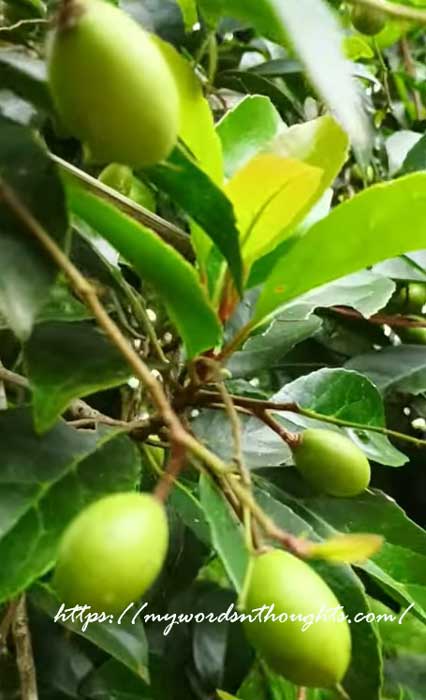
We had one Karakka tree in our house premises. It was not planted, but grown somehow; maybe from some dispersed seed. Even my early childhood memories have this Karakka tree. Near to it, there was a guava tree, Rose apple (Champakka) tree, Mango tree, Jackfruit tree, Custard Apple and a few more. I can’t remember all. Those days, it was so common to plant trees in courtyard and house compound. That generation gave a lot of importance to plant trees, and preferred to use fruits from home-cultivated trees.
Those days we love to play with ripen leaves of this tree, because they are more like Indian version of maple leaves. When the leaves become old, they change from green to a shade of red, mixed with some shades of pink, orange, yellow and a few shades, which I can’t clearly say. We, kids as a group used to eagerly wait, when will our tree blossom and finally give fruits. As kids, we loved both fruits and salted Karakka, which we always bought from shops. I think, it was during my early teens, while we four (two of them are first cousins) were playing around trees when I spotted a fruit hiding behind leaves.
At first, I couldn’t believe my eyes. When I showed it my group, I saw the same excitement on their faces too. It was green, not fully ripen. Our next thought was, how to get it. Using stones and sticks, we somehow managed to bring it down. I was the one to take the first bite of this small Karakka, followed by other three. Decades have passed. Those memories are still fresh.
After that, our Karakka tree started giving fruits frequently. Though the excitement of having its first bite has gone, we still loved it! The tree, which was small during our childhood, grew along with us. It was there, even after my daughter was born. Suddenly, the tree’s leaves started to dry without any reason, and slowly it died!
I still remember my brother’s words – This tree will go. If you want its memories, take a few photos and keep them. Yes, I took a few clicks of those dying remains – something which bonds us with our glorious childhood days. But I don’t think, I have those pics now. Along with a few more folders of my daughter’s early pics, I lost them too! It happened after I couldn’t retrieve data from my PC’s old hard disk. But those ‘Karakka memories’ are here to stay — and linger forever.
To add: While I stayed in Thrissur for nearly 18 years, I never got opportunity to see or have this fruit or salted one. Nobody from there really know about Karakka. Then only I realized, this fruit is not available across Kerala.
Also read: A return journey to the nostalgic days of ration shops (ration kada)
Also read a few posts on Kerala culture, heritage, and social life. Click on the links in the page to read.







Recent Comments