
Birendra Kumar Bhattacharya was a doyen of Modern Assamese Literature, who authored Socio-Political & Historical Novels, Short Stories, Biographies & Historical Non-Fiction, Travelogues, Literary Criticism, Satire & Plays. He was the first-ever Assamese writer to win the Jnanpith Award (1979). He was a frontline journalist, a teacher, a social activist, and a literary revolutionary.
He served as the President of Assam Sahitya Sabha during 1983–1985. His masterpiece novel, Iyaruingam, won the Sahitya Akademi Award in Assamese in 1961. His books covered multiple genres, heavily influenced by leftist ideals, the Indian freedom struggle, and the socio-political realities of Northeast India.
Birendra Kumar Bhattacharya – The Recipient of the Jnanpith Award in 1979
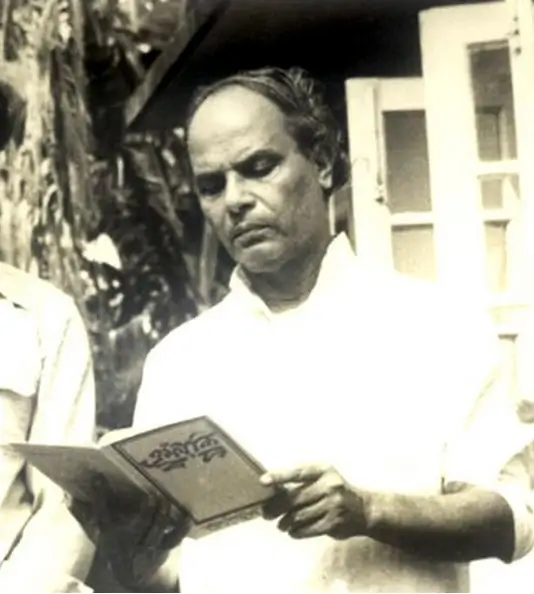
He was born in Assam Province of British India on 14 October 1924 in the serene environment of Safrai Tea Estate in Sibsagar (now Sivasagar). He grew up in the tea estate, which influenced him a lot as a child, and also in his later life and literary works. He closely watched the intense labour of the working class on one hand, and the rigid British colonial administration on the other, which shaped his consciousness.
He was a brilliant student in his studies, and Birendra completed his graduation in science from the prestigious Cotton College in Guwahati. Much later in life, he earned his Master of Arts and a PhD from Gauhati University for his intensive research on the humour and satire found in Assamese literature. He published his first novel, ‘Rajpahte Ringiai’, in 1957, followed by Aai the next year.
Bhattacharya’s Professional Journey
Birendra didn’t stick on to a single profession. During the initial days, long before he became a celebrated writer, he was a fierce journalist. In the late 1940s, he moved to Kolkata to work for the progressive Assamese journal Ramdhenu. By the 1950s, he turned an editor of the same journal. He played a magnificent role in making the journal a definitive launchpad for modern Assamese literature, discovering and nurturing an entire generation of young poets and avant-garde writers.
He worked among the Tangkhul Naga tribe of Ukhrul, Manipur, where he worked as a teacher. His real experiences during those days were reflected in his work, Iyaruingam, a ground-breaking novel which won him the state Sahitya Akademi Award in 1961. His novel, ‘Shataghni’ (1964), was based on the Chinese attack on India.
His novel Mrityunjay won the Jnanpith Award in 1979
Over the years, his works reshaped the status of regional literature on the national stage. It became a feather on his cap when he brought the prestigious Jnanpith Award to Assamese soil for the first time in 1979. He won the honour for his epic novel Mrityunjay, which is his most celebrated work. Primary themes of his works include Tribal rights, anti-colonial struggle, and post-independence disillusionment.
Birendra Kumar Bhattacharya used to write literary criticism even for younger writers. Whenever he found a spark in their work and believed they had a promising career ahead, he always reviewed their work. He continued this process till the mid-1980s.
Birendra Kumar Bhattacharya’s other major published works
He remained one of the most respected Assamese novelists and short story writers of all time. Dhanpur Lashkar, Billari, Blossoms in the Graveyard, Pratipaad, Love in the Time of Insurgency and Aai are among his published novels. He also excelled in writing short stories. He also published a collection of short stories, like Kolong Aajiu Boi and Satsori. He also published a few poems in the magazine ‘Jayanti’.
Many of his works have been included in the syllabus of schools and colleges. Apart from contributing to Modern Assamese literature, he also discovered several extraordinary literary talents and promoted them. Birendra Kumar Bhattacharya passed away on 6 August 1997, aged 72.
Also, read about the second recipient of the Jnanpith Award from Assam – Mamoni Raisom Goswami







Recent Comments