
The lines of Bhava Gayakan (emotional singer) accompanied me on the journey to the Thiruvambadi Krishna Temple.
“Ambady Thannil Orunni Thiru-
Vambady Krishnanaamunni…..
Unniykk Thrikkayyil Ponnoda Kuzhalu
Kuzhalil Churakkunnathamruth…..”
Lines can be translated as…..
“A little Krishna lived in Ambadi,
Ambady Krishnanunni
In his royal hands, a golden flute,
From which flowed sweet elixir.”
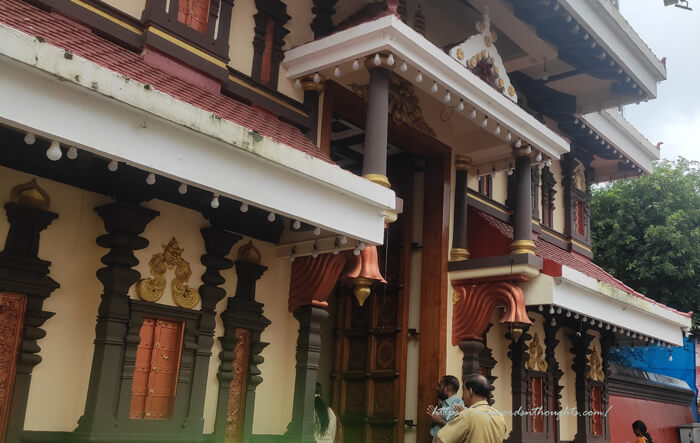
P. Jayachandran’s majestic voice made the image of young Krishna run freely through my mind. As dusk slowly lit up the sky above Thekkinkadu, I felt the urge to climb up to see Thiruvambadi Kannan. There is no need to wait for the festival season to worship Unni Kannan.
Thiruvambadi Krishna Temple – Thrissur’s own Unni Krishna
Thrissur town is filled with constant crowds. In the middle of this busy city stand the Vadakkumnathan Temple and Paramekkavu, tall and proud. A little further is Thiruvambadi (also written as Thiruvambady), around 1 km away. And right at the heart of the city is the world-famous Thrissur Pooram, where a sea of people gathers in celebration. Can any other city in Kerala offer such a sight?
Decorated with flowers and lamps, the Thiruvambadi Krishna Temple echoes with festive music. People arrive from different places to attend the festival and for darshan. During the festival season, usually in April, Thiruvambadi enters a series of special days. The festival season comes in the month of Medam. In the heat of Medam, Vishu, the blooming of kanikonna flowers, and the Thrissur Pooram all come together at Thiruvambadi, and sometimes a few weeks apart.
Guruvayur and Thiruvambadi – Thrissur’s pride
Thiruvambadi is one of the temples where the festival flag is hoisted along with the Guruvayur Temple festival. The flag hoisting here also takes place on Pooyam star in the month of Kumbham, the same day as Guruvayur. While the Guruvayur festival lasts 10 days ending with the famous aarattu, the festival at Thiruvambadi lasts 8 days only—this is the main difference. There are many similarities not only in the festivals but also in the daily rituals and worship.
The temple faces west, and the presiding deity is Unnikannan (child Krishna), holding butter in one hand and a flute in the other. An important and unique feature of this temple is that the Goddess (Bhagavathi) is given equal importance as Krishna. She is consecrated beside him and is believed to be in the form of a young girl. She is also considered the sister of Shankaramkulangara Bhagavathi.
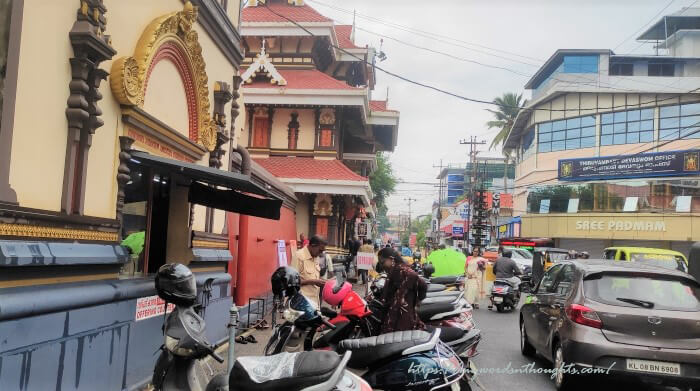
The temple opens early in the morning, around 4:30 a.m. The main ritual then is the Palliyunarthal (awakening the deity), a common ritual of all Hindu temples. This is followed by bathing the idol, changing the decorations (Vaakacharth), and performing abhishekam and alankarams. Oil bath, sandalwood paste, milk abhishekam, and conch-water abhishekam (Shank Abhishekam) are performed before preparing the deity for darshan. The sanctum opens amidst fragrant flowers, incense, lamps, and divine light. Seeing Krishna bathed in lamplight during the early morning darkness is a truly beautiful sight.
Daily annadanam (free food offering) is a special feature of the Thiruvambadi temple. On Ekadashi, nearly 80 paras of rice are used for preparing the prasadam feast (Prasadam Oott). At present, the Devaswom has three mandapams and four elephants.
The Edakkalathoor Legend
If you ask elders who have been visiting the Thiruvambadi Temple for a long time, you can listen to old legends and some untold tales about the Thiruvambadi Krishna Temple unfolding in front of you. One well-known story is about the connection between Thiruvambadi Temple and the Edakkalathoor Temple.
According to legend, during a time of community conflict, a priest escaped carrying the idol. He reached the house of a childless couple at Kachanappilly Illam (Brahmin’s ancestral home), handed over the idol, and requested them to protect it like their own child.
The couple worshipped the idol for a long time. Later, realising that the deity was Unnikannan (Child Krishna), they took the idol to Thiruvambadi and began proper temple worship there. Since the deity at Edakkalathoor is Parthasarathy, it is believed that Parthasarathy is also worshipped here.
There is another legend associated with the temple. When Sakthan Thampuran was building the city and grounds of Thrissur, stone troughs were brought from the Viyyur region for elephants to drink water. The elephants dragged these heavy stone troughs. When they reached the Thiruvambadi area, the troughs reportedly would not move any further. Realizing the presence of divine energy at that spot, a temple was built there.
The chief priests of the temple are Pozhichur Dinesh Namboothiri and Vadakkedath Kaplingad Pradeep Namboothiri. Since each deity has distinct rituals and methods of worship, the ceremonies here are marked by great variety. Also read about Thiruvambadi Siva Sundar – The beloved temple elephant
Deities, Rituals, and Festivals
Thiruvambadi Temple is not dedicated only to Lord Krishna and the Goddess. Many subsidiary deities (Upadevata) are installed in different corners of the temple, each with separate rituals. Ganapathi, serpent deities, Brahmarakshas, and Ghantakarna are also worshipped here. Ashtapadi is offered as an archana (offering) to Lord Krishna. Along with vocal offerings, instrumental worship using chenda drums and nadaswaram is also performed.
From the first day of the Malayalam month of Vrischikam, Bhagavathi Kalampattu begins, followed by the evening procession of the oracle (Komaram). After 41 days of Kalampattu, the Vela festival is held in the month of Dhanu. On the tenth day, the oracle officially announces the Vela. The Komaram of Thiruvambadi is Sethumadhavan of Palapparambu at present, the nephew of the Komaram from the Guruvayur Idatharika Kavu. The festival concludes with Guruthi performed outside the temple premises under the leadership of the Kuruppans.
Vishu Kani – Auspicious First Sight at Thiruvambadi every year
On Vishu day, Kani darshan at Thiruvambadi begins at 3 a.m. The deity is viewed along with the decorations arranged the previous night. The Vishu Kani items are prepared and displayed for Lord Unnikannan. These include raw rice, jackfruit, mango, cucumber, a metal mirror (Aranmula Kannadi), a freshly washed mundu (Kerala traditional off-set colour dhoti), a broken coconut (into two halves) with a lit wick, and golden cassia flowers (kanikonna). First, the Kani is shown to the deity, and only then are the temple doors opened for devotees to have Kani darshan.
The Kani darshanam lasts for about 1.5 hours. Even after this time, devotees continue to queue up to have darshan of Lord Krishna on Vishu morning. On this day, as it is crowded, entry into the inner courtyard (nalambalam) is not allowed. Also read: Do you know the story behind Oru Neramenkilum song?
Special Offerings at Thiruvambadi Krishna Temple
The most beloved offering of Thiruvambadi Bhagavathi—Chathushatham Payasam—is prepared only during the Vela festival. It is made using coconut milk and jaggery under the guidance of around thirty Namboothiri priests. Another important offering is a pot of milk payasam. Also read: Do you know the story behind the creation of these popular songs of Guruvayurappan?
Many devotees make a vow to visit Guruvayur, as nothing can replace that pilgrimage. However, when they are unable to go there, they come to Thiruvambadi instead, which brings them comfort and peace.
Festival as a Space for Art
For many people, the Thiruvambadi temple festival is also an opportunity for artistic worship. Afterall, art is a form of devotion and worship too. Classical dance forms such as Bharatanatyam and Kuchipudi, along with music programmes, are performed during the festival. Thiruvathira dance groups also arrive to present their performances as part of the celebrations.
In 2025, during the first week of the festival, a Thayambaka competition was organised for young percussion artists. Devaswom Committee members said that around 30 to 50 Thiruvathira groups usually come to perform here. Satisfaction gained from performing Thiruvathira as part of the festival is truly special.
Earlier, Krishnanattam and Kathakali were given more importance at the Thiruvambadi Krishna temple. Now, the temple committee is trying to encourage other classical art forms as well, said Kalamandalam Rajesh Kannan, a native of Alathur–Vadakkenchery and Director of Shoothilaya Kalakshetra, who came this year to present a dance performance. The performance was presented by Rajesh and his group, consisting of family members and disciples from Ollur.
This is how Thrissur Pooram came into existence

Thrissur Pooram – The world-famous festival and the greatest of all Poorams that Malayalis cherish in their hearts is hosted by the Thiruvambadi Temple and the Paramekkavu Temple. Although Thiruvambadi is dedicated to Lord Krishna, the legend of the Pooram is closely associated with the Goddess, who resides alongside Krishna here. Listening to the blend of history, legend, and the rhythms of Panchari Melam is a delightful experience, and each Pooram lover will have a different experience to ponder.
According to belief, the Pooram began as the result of a firm decision taken by Shakthan Thampuran. Before the Thrissur Pooram gained fame, the Arattupuzha Pooram was the most renowned festival. Temples from Thrissur regularly participated in the Arattupuzha Pooram.
Once, due to heavy rains, a group that had set out from Thrissur reached Arattupuzha late. As a result, the people of Arattupuzha excluded the Thrissur temples from that year’s Pooram festival.
Upset by this exclusion, the people informed the Raja of the region. Shakthan Thampuran then decided that Thrissur should have a separate Pooram as grand as Arattupuzha’s. This decision led to the birth of Thrissur Pooram, which historians say began in 1798. At that time, the area now known as Thekkinkadu Maidan was a forest. The word Thekkinkadu itself means ‘Forest of teak trees’. Shakthan Thampuran cleared it and transformed it into a public ground to conduct the festival.
He also divided the Thrissur temples into two groups—Thiruvambadi and Paramekkavu—to participate in the Pooram procession. Along with Thiruvambadi are the temples of Kanimangalam, Laloor, Ayyanthole, and Neithilkkavu. Along with Paramekkavu are Karamukku, Chembukkavu, Choorakkottukavu, and Panamukkam Pillai temples. The main Pooram takes place on the Pooram day of the Malayalam month of Medam, marking the end of the annual festival with Pakal Pooram the following day.
Thiruvambadi and Paramekkavu together conduct Thrissur Pooram

The most spectacular events of Thrissur Pooram—the Kudamattam (umbrella exchange), melam, and fireworks—are jointly presented by Thiruvambadi Krishna temple and Paramekkavu Bhagavathy temple. The office bearers of the Thiruvambadi Devaswom Committee are actively involved in the preparations. For a few days, there will be a display of umbrellas and other Pooram accessories near the respective temple venues, attracting many devotees. This display is known as Chamaya Pradarshanam.
In 2025, the Pooram flag was hoisted on April 30, and the main Pooram celebrations were held on May 6 and 7. Preparations for the traditional melam and fireworks began well in advance, following customary practices, and they will be followed in upcoming years too. Read more about less-heard facts of Thrissur Pooram
Rituals and the Emotional Farewell of Thrissur Pooram
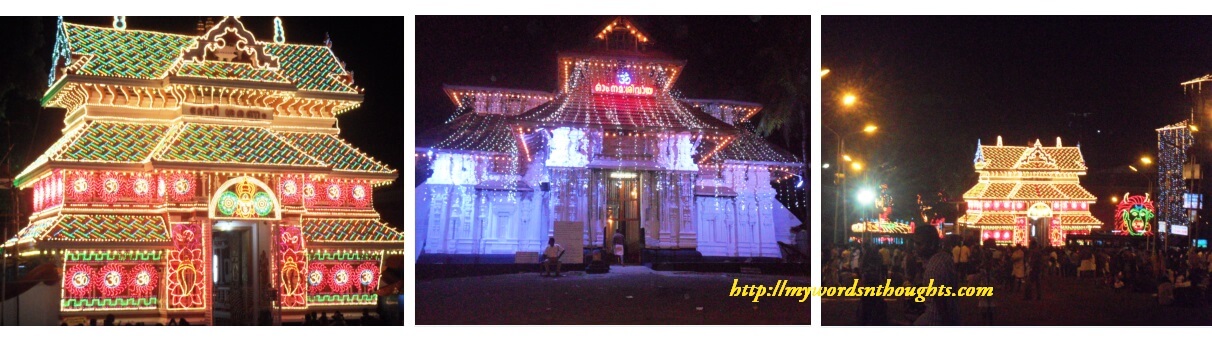
Decorated Thiruvambadi, Vadakkumnathan and Paramekkavu during Thrissur Pooram Fortnight
After flag hoisting, the Goddess goes for daily Aarattu in the morning. On Pooram day, she proceeds to the Mathilakam by 8 a.m., where Irakkipooram is held. The famous Mathilakam Varavu happens at 11 a.m. After the night Kudamattam, the deity returns to the Mathilakam. Only after the Uchcha Pooram the next day do Thiruvambadi and Paramekkavu Bhagavathies exchange formal courtesies and separate.
The second day, called Pakalthooram or Day Pooram, holds special significance for women. In earlier times, women were busy hosting guests on the main Pooram day and could not attend. Hence, the second day became their celebration, history certifies.
Upacharam Chollal – The Final Farewell of Pooram
Every Pooram creates lasting memories. Kudamattam, Mathilakam Varavu, melam, and fireworks fill the senses. But the final ritual—Upacharam Chollal—brings a quiet ache to devotees’ hearts.
The two Goddesses stand facing each other and exchange courtesies. Suddenly, the thunderous sounds fall silent. Some devotees weep, wondering whether they will witness the next Pooram. Others feel a sadness as they descend from the festive, magical world back into everyday life. Yes, there have a few occasions when the annual Pooram was not held. The Corona pandemic is one such rare occasion when Thrissur Pooram was not conducted in 2020. There have been a few more times when Thrissur Pooram, regarded as the ‘Mother of all Poorams’, was not conducted. Read more to know.
With these emotions, Pooram lovers bid farewell—waiting once again for the next year. Until then, they continue to visit Thiruvambadi and Paramekkavu seeking blessings from the Goddess.
Also read 10+ posts related to Thrissur Pooram. Click the links to read.



Recent Comments