
Perumanoor Gopinathan Pillai, popularly known as Guru Gopinath (24 June 1908 – 9 October 1987) was a legendary Kathakali artist, guru and choreographer. He was one among the first batch of students at Kerala Kalamandalam. His status is equal to Uday Shankar and many other iconic figures of Indian Art of the 20th century, who popularised Indian art forms across the globe.
Guru Gopinath was a cultural icon of Kerala who was instrumental in introducing and popularising Kathakali to the outside world. He formulated and conceptualised Kerala Nadanam, an art form with simplified steps.
Guru Gopinath – An Iconic Figure of Kathakali in the 20th Century
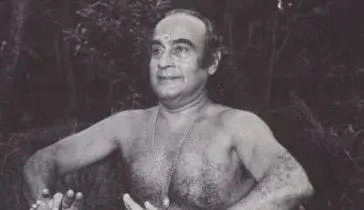
Gopinath was born on 24 June 1908 at Champakkulam in Kuttanadu of Alappuzha District into a family of performing artists. Madhavi Amma and Sankara Pillai were his parents. He belonged to the family of the famous Kathakali dancer and guru, Kunchu Kurup. Champakkulam Paramu Pillai – his grandfather, and Champakkulam Pachu Pillai – his elder brother, were Kathakali performers.
He took formal learning from Champakkulam Paramu Pillai, Mathur Kunju Pillai Panicker and Thakazhy Kesava Panicker in several art forms, including Kathakali. Young Gopinath learnt both the southern (Kaplingadan) and northern (Kalluvazhi) style of Kathakali. He has also trained in various classical art forms, including Bharathanatyam and Kuchipudi. He was invited by Vallathol to Kerala Kalamandalam for higher studies when it was just formed.
In 1936, he married Mulakkal Thankamani Amma, one among the first batch of Mohiniyattam students of Kerala Kalamandalam. After marriage, she played a magnificent role in formulating Kerala Nadanam and also taught many disciples, thus popularising this newly created art. The couple had 3 daughters and one son – Vinodini Sasimohan, Vilasini, Vasanthi and Venugopal. While the daughters stepped deeply into dance and performance, Guru Gopinath’s son Venugopal kept a relatively low profile.
Vallathol personally invited Gopinath to Kerala Kalamandalam during the founding year
When he joined Kerala Kalamandalam as its first batch student, Kalamandalam Krishnan Nair and Ananda Shivaram were his batchmates. He was fortunate to train under some of the greatest figures of the 20th century. He trained under Pattikkamthodi Ravunni Menon, Guru Kunchu Kurup and Guru Kavalappara Narayanan Nair. He studied Rasa Abhinaya under Natyaacharya Mani Madhava Chakkiyar.
His association with Ragini Devi, an American-born dancer from Michigan
Ragini Devi, formerly Esther Luella Sherman, was his dance partner, and they performed together for the first time in Mumbai in 1932. Though he mostly performed on classical art forms dealing with Hindu mythological subjects, he also brought socially relevant and political subjects into his performances. He also choreographed and performed ballets.
Guru Gopinath formulated and conceptualised Kerala Nadanam in the 1930s
He created this art form and performed it alongside his dance partner, Ragini Devi. Kerala Nadanam is a stylised, creative offshoot of Kathakali. When Guru realised that the traditional Kathakali is highly complex, intensive, and mostly understood only by royal courts and scholars, he wanted to bring the magnificent grammar of Kerala’s classical dance to the common public and a global audience. This idea developed into the art form, Kerala Nadanam.
He simplified costumes & makeup, and introduced elegant and Kerala traditional costumes, inspired by the iconic paintings of Raja Ravi Varma. He simplified themes and language and introduced Kerala Nadanam to female performers at a time when male artists had a monopoly over Kathakali. He made a beautiful male-female dance pair and created group choreography. He also replaced the wide, rigorous stance of Kathakali with the fluid, “S”-shaped Tribhanga posture, making it more attractive.
Guru Gopinath carved out a contemporary style of dancing, classical in form but popular in appeal. He introduced this art form globally as “Oriental Dance” or “Kathakali Natanam.” It was later renamed as Kerala Nadanam and recognized as Keraleeya Shaastriya Sargaathmaka Nrittham (Kerala classical dance form).
Kerala’s greatest preserver of Kathakali
Apart from popularising Kathakali and related art forms globally, he also preserved them. He is a recipient of the Sangeet Natak Akademi Award, the Kerala Sangeetha Nataka Akademi Fellowship, and the Kerala Sangeetha Nataka Akademi Award.
Guru Gopinath – Some interesting and lesser-known facts
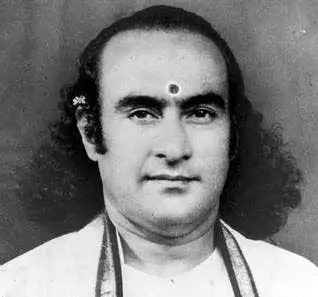
1. In the 1930’s, Rabindranath Tagore watched his live performance and sent him an appreciation letter. The Rabindra Bharathi University also honoured him with a doctorate.
2. He received the Veera Srumkhala from Chithira Thirunal Balarama Varma, the King of Travancore. The royal family immensely supported his work, appointing him as the palace dance. They also backed Sree Chithrodaya Narthakaalayam in Thiruvananthapuram —the very first institution to teach Kerala Nadanam.
3. He appeared in a few films also.
4. His daughter, Vinodini Sasimohan, is the Chief Administrative Officer of Viswa Kala Kendra, Thiruvananthapuram. She has also worked as a child artist in Malayalam films in the 1960s. She played the titular role in the mythological film, Devi Kanyakumari – her most popular role.
5. His daughter, Vilasini, became an IAS officer in Gujarat.
6. He authored a few books in Malayalam and English, which explain the theory and practice of Indian and Kerala dances.
7. Among his choreographed pieces, his last choreography, ‘Ramaayana’ ballet, was the most popular one. It was staged more than 1500 times in various parts of Kerala.
8. In the Malayalam film, Prahlada (1941), Guru Gopinath played Hiranyakasipu, while Thankamani played Kayathu. Thankamani also rendered her voice for one song. It was the third talkie of Malayalam cinema.






Recent Comments