
Adyar K. Lakshman was a well-known Bharatanatyam dancer, choreographer and teacher, who also excelled in Carnatic music. He was the founder of Bharatha Choodamani Academy of Fine Arts on August 22, 1969. He was a recipient of numerous honours, including Padma Shri (1989) and Sangeet Natak Akademi Award (1991. He had a brief association as a choreographer in South Indian movies, too.
Adyar K. Lakshman – Classical Dancer, Percussionist and Vocalist, A rare feat
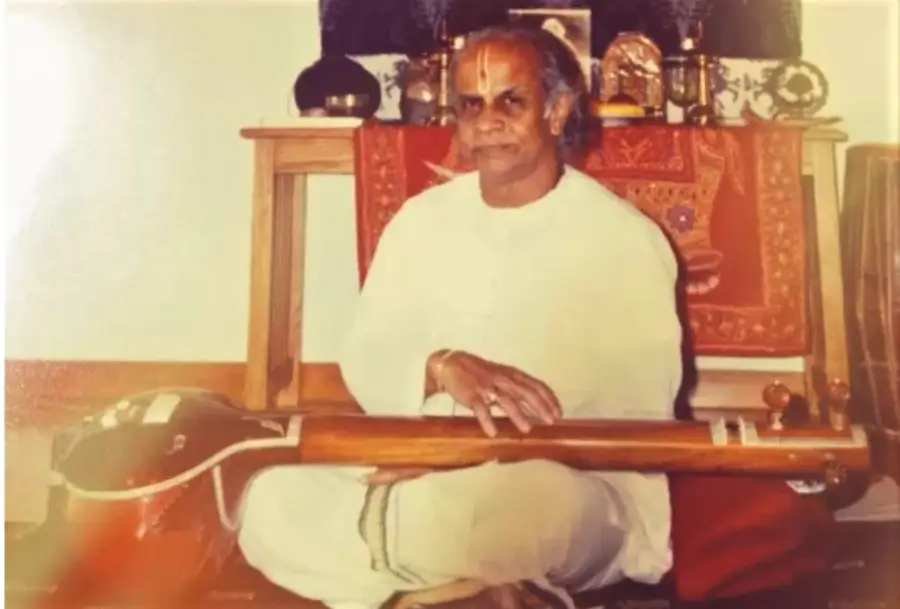
He was born on 16 December 1933 in British India. His birthplace, Kuppam, then a part of Madras Presidency in British India, now belongs to Andhra Pradesh. His father, Krishnaraja Rao, was a school master. He, along with his brother Rama Rao, was discovered at a young age by P.D. Doraiswamy Iyer, a representative of Bharatnatyam dancer Rukmini Devi Arundale, when their father was posted there.
When Krishnaraja Rao received an invitation to admit his sons to the Fine Arts School owned by Rukmini Devi Arundale, he happily accepted it. He sent his children to the dance school. Interestingly, Lakshman was originally scouted for Kalakshetra as a music student because of his beautiful singing voice. Iyyer was specifically looking for young talent to bring into the Kalakshetra fold (during the initial years and still in a primitive stage), and Lakshman’s vocal skills were the primary draw.
As a kid, Lakshman was initially reluctant to join the school because he thought that dancing was exclusively meant for girls. Rukmini Devi Arundale famously persuaded him to take up dance as a “physical exercise” when he was obsessed with cricket at the time. Then Lakshmanan began his training.
Adyar K. Lakshman was only 11 when he joined Kalakshetra
Lakshman began his education at Kalakshetra in 1944, where he underwent rigorous training of vocal music, Bharatanatyam, Mridangam and Nattuvangam. He also got the opportunity to train under Rukmini Devi Arundale and Sarada Hoffman during his stay at Kalakshetra. During his first 4 years, he was so much drawn towards cricket. At this point, Rukmini Devi asked him to make a choice between dance and cricket. When she said, a cricketer can play only till around 35, but a dancer can perform during middle-ages, and later, he chose dance over cricket.
Lakshman also got the opportunity to closely associate with great maestros such as Mylapore Gowri Ammal, K. N. Dandayudhapani Pillai, S. Saradha, Tiger Varadachari, etc. He graduated in 1954 from Kalakshetra in Bharatanatyam, Carnatic music and Nattuvangam. For the next two years, he stayed in the dance school and got a Government of India scholarship for higher studies.
With this scholarship, Adyar K. Lakshman studied a post-graduate diploma in 1956. Later, he specialised in mridangam and also learnt Kathakali, thus proving his versatility. He learned Kathakali from Ambu Panicker and Chandu Panicker.
His career as a performer, choreographer and guru
After studies, he joined actress Vyjayantimala Bali’s school, Natyalaya, as a teacher, where he spent more than a decade and conducted many arangettams. In 1969, he founded Bharatha Choodamani Academy of Fine Arts and taught numerous students.
Along with it, he choreographed noted drama productions like “Varunapuri Kuravanji” and “Aiychiar Kuravai,” under Bharatha Choodamani Academy of Fine Arts, owned by him. He also worked as a choreographer for movies like “Hamsa Geethe”, “Subba Sastri” and “Ananda Tandavam”.
Know more about the legend
1. Adyar K. Lakshman joined Kalakshetra as a musical student, but later learnt different classical dance forms alongside Carnatic music. He excelled in different fields, which is a rare feat.
2. He became one of the few dancers to share the stage with his guru and mentor, Rukmini Devi herself and was a lead in legendary productions like Kumara Sambhavam and Sita Swayamvaram.
3. As he was a trained Carnatic Vocalist, he started singing for AIR since 1958.
4. He was a skilled percussionist who accompanied many great classical dancers like Yamini Krishnamurthi and Vyjayantimala Bali. He sang and also performed musical instruments like Mridangist and Nattuvanar, behind the curtain, for such performances.
5. He mastered Nattuvangam when it was only traditionally performed by artists, thus breaking norms. Now he is hailed as one of the foremost Nattuvanars.






Recent Comments