
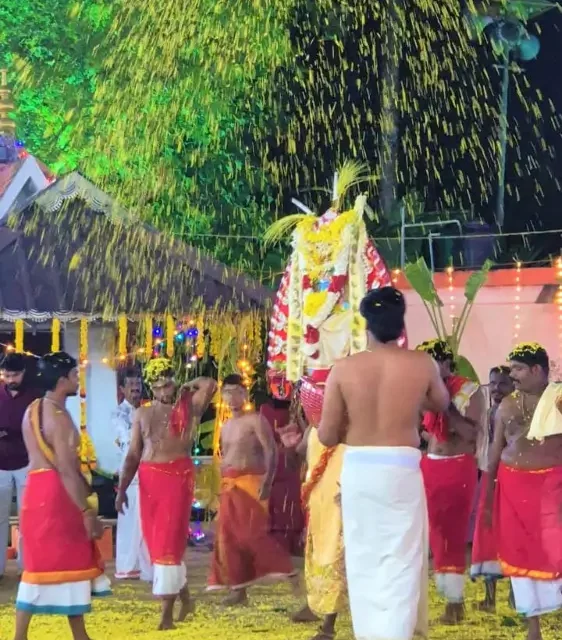
Today, for the first time, I watched the ritualistic performance of Kalamkaval, normally carried out in Bhadrakali temples (Mudipura) in the southern parts of Thiruvananthapuram district. For the last 18 years, I have spent time in Thrissur and have come across similar temple rituals, such as Ayyappa Vilakk and Nirapara, while missing many of my native temple festivals.
Those who have recently watched Mammootty’s 2025 thriller would be familiar with the term Kalamkaval. But what does it actually mean? Today I experienced its divinity, and it reminded me of Nirapara held at homes in Thrissur, and the ritualistic Theyyam of Kannur and other northern parts of Kerala.
Kalamkaval also reminds you of Bhootakola and the movie Kantara, where the Goddess herself enters the priest’s body, who performs the act. carrying the Thirumudi (the sacred headgear/idol of the Goddess) on his head. Throughout the ritualistic performance, a person dressed as Goddess Bhadrakali searches for the asura Darika.
Kalamkaval – A key segment of the larger Kaliyoottu festival
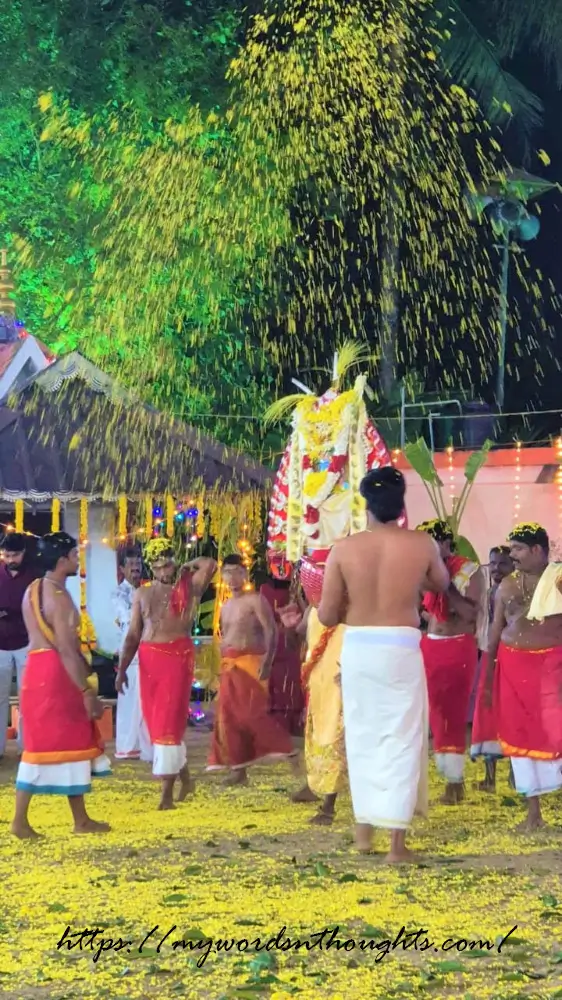
Kalamkaval (often spelled Kalankaval) is a high-energy ritualistic procession and performance, normally held during the annual celebrations of Bhadrakali temples in the southern parts of Thiruvananthapuram district. These temples are generally called Mudipura, which lack a proper idol, unlike most Hindu temples. A sacred headgear is worshipped as the idol, and during the festival season, she often goes out to bless her devotees.
What is the Kaliyoottu festival?
The Kaliyoottu festival symbolises the mythological battle between Goddess Bhadrakali and the demon Darika, and different segments of the festival like Kalamkaval, Ucchabali, Nilathilporu, Dikkubali and Paranettu add more colours, rhythms and celebrations to the event through dramatic ritual enactments. All these temple rituals represent the significant battle between Goddess Bhadrakali and the demon Darika.
The Kaliyoottu Mahotsavam of Vellayani Devi Temple is the most popular among them, and the temple festival is conducted for around 65 to 70 days, once every three years. Sarkara Devi Temple of Chirayinkeezhu and Kundamanbhagam Sree Bhadrakali Temple are other major temples where Kalankaval is a highlight.
Kalamkaval held at the Karingal Thottakara Sree Bhadrakali Devi Temple
Today I watched the Kalamkaval performance at night at Karingal Thottakara Sree Bhadrakali Devi Temple, located on the Arumaloor–Kattakkada road near Maranellur. It’s a part of the ongoing Thookkam Mahotsavam. After a long gap, this sacred floor ritual was arranged here, and for the next few years, the temple will undergo renovation. For the same reason, the annual temple festival will not be held in the coming years as part of the renovation process.
There are two goddess idols in the temple, and during the festival season, the second deity stays outside the main temple. A temporary settlement is made for the goddess, and on alternate days she goes out to bless her devotees. Starting early in the morning, she goes in one direction each day and may return late at night. She rests the following day, and during that night, she performs Kalamkaval in the temple premises. Kalamkaval is performed multiple times as part of the temple festival.
How is Kalamkaval performed?
The priest who performs this act is called a Vathi or Kaniyar, and he transforms himself into the representative of the Goddess. He is always accompanied by a group of people who throw leaves and flowers on him, and the whole group circumambulates the temple multiple times until the Vathi becomes unconscious.
A group of Chendamelam artists enhance the rigorous movements of the Vathi, creating a trance-like environment for both the performer and the devotees. They normally stand and perform in front of the main deity (the main deity stays inside the temple, and the temple door remains open until the whole Kalamkaval performance is completed at night around 9 pm), while the priest and the group move around the temple the whole time. Ilathalam percussionists also accompany the Chenda artists.
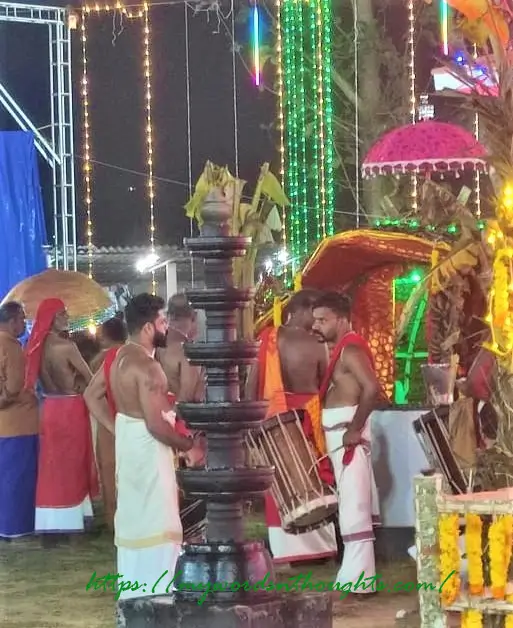
The act begins with slow beats of the Chenda, and at times it reaches a trance mode. Its pace keeps changing according to the dance steps of the performer. The priest takes the Thirumudi of the idol kept outside the temple, and the group follows him. Initially, they circumambulate the temple three times, and the group tries to please the goddess by showering different kinds of leaves, which they carry in baskets. During the initial stage, lamps are lit on the top of the idol, and slowly they are turned off.
Starting with slow-paced steps, the performer dances and his accompanying group throws leaves on the idol. They circumambulate the temple, and they keep changing different kinds of leaves.
Showering leaves is followed by flowers and puffed rice (malar)
After some time, flowers are introduced to the act, and it is spectacular to watch the change of marigold petals from yellow to orange, and then to red rose petals and puffed rice, which the goddess likes the most. The group tries to pacify her by offering flowers and rice, and the priest starts searching for Tharaka among the spectators.
At this point, the Kalamkaval act turns more rigorous and interactive, and it becomes a direct interaction between the goddess and her devotees. The temple premises appear like a bed of multi-coloured flowers, and it is common to see small children playing with them.
When the steps turn faster and faster, the Chendamelam beats also reach their peak, but remain rhythmic. The Vathi then takes weapons for his final act to kill Tharaka, and he turns aggressive. He moves into the crowd, and his associates instruct the spectators to step back for safety. His weapon includes Shulam (a trident), which the goddess always carries and often uses to kill demons.
The whole act can go on for one hour or more. At the end, the goddess leaves his body, and he falls unconscious.
The significance of Kalamkaval
The word “kaval” means guard or protection against the demon appearing in various forms. It is an intense symbolic guarding or defence phase where the goddess moves in different directions to counter the demon’s illusions (Maya). Fierce movements, trance-like states, and the Velichappadu (oracle) carrying the deity’s idol or sword on his head are its highlights.
It is a folk-religious art form tied to Bhadrakali worship, emphasising protection, victory over evil, and community devotion. Though it may appear similar to Theyyam, which is focused on multiple deities, they are entirely different art forms.
The name gained wider attention recently after the release of the Mammootty-starrer film with the same title. Since the crimes shown in the film happen in the shared border areas of Thiruvananthapuram and Kanyakumari, the title is quite apt. The film uses the ritual as a metaphor for themes such as illusion, hidden demons, the hunt, and final justice.






Recent Comments