
Kerala Payasam and Pradhaman Traditions
When a Kerala sadya is served on a banana leaf, this dish comes among the last items. It follows one or two servings of rice and nine or more side dishes, apart from curries. Yet, on the banana leaf, payasam or pradhaman is the king of all the items served. It comes last, but stays on the taste buds forever. No sadya is complete without payasam or pradhaman, even if dozens of items are served. Without payasam, even all the curries and special dishes served won’t earn the tag of ‘Kerala Sadya’.
Let me unfold Kerala Payasam and Pradhaman traditions, which are not familiar to the new generation. Through this column, let me share a few interesting tales of Kerala’s own payasam.

What is the real story of Payasam?
Payasam derived from Payass
Kerala Payasam and Pradhaman traditions go back many centuries. As per belief, with the arrival of Brahmins in Kerala, payasam also became an integral part of Kerala cuisine. Payas means “milk”, and when a dessert is made using milk, it becomes Paal Payasam (milk payasam). Payasams are of different varieties. Yet, Ada Pradhaman holds a prominent position among them. When Ada Pradhaman is made using milk, it becomes Paalada Pradhaman, which is widely regarded as tastier and more popular than other varieties.
Pradhaman means “someone who comes first”, and that may be the reason this tag was added to Ada, the most popular payasam. Ada is closely associated with Kerala’s culture, customs, and several beliefs. Also read: What’s the difference between payasam and pradhaman?
In temples, ada is offered as nivedyam as well as a temple offering to please the Lord. In certain regions of South Kerala, Ada Nivedyam is performed during Onam celebrations. For rituals like Pithru Bali, ada holds a prominent position. This may be the reason why payasams with ada added are given the first position (Pradhaman).
In many families, making payasam is a combined effort of all its members. The scraping of coconut is done by the elder daughter; melting the jaggery is done by the mother; the preparation is handled by the grandmother; and extracting coconut milk is handled exclusively by the male members of the family.
Payasams and Pradhamans for rituals and celebrations
Onam celebrations in the kitchen

During the Onam season, much preference is given to pookkalam, onakodi, and onasadya. The preparations done in the kitchen for making onasadya are nothing short of a celebration. Some 40 years ago, payasams were prepared in the kitchen only during special occasions such as Onam or Vishu. At a time when mixers or grinders were not available in kitchens, male members entered the kitchen only to extract coconut milk from scraped coconut. Before they started the process of squeezing coconut, cotton towels would be kept ready. Clean towels were soaked in water before the process began.
Scraped coconut was transferred to big urlis. Then it became the job of the male members to extract coconut milk from the coconut. They used coconuts with the fibre and husk removed to crush the scraped coconut first. Then began the real war! A little coconut was placed in a moist towel, squeezed from both ends to form a rope-like structure, and the first milk (thala paal) was extracted. The more first milk you extract, the tastier the payasam will be.
Next, a little water was added to the extracted pulp, and it was crushed again before the second milk was extracted. Then a little warm water was added to the pulp, pressed well, and the third milk was extracted. Sometimes, the coconut pulp was crushed in a stone ural before the process to get more juice.
During those old, glorious yesteryears of Onam celebrations, most families had many members. So Ada Pradhaman was not common during celebrations, as it was not easy to serve a large number of family members in a joint family. Therefore, dry rice (unakkalari) or green gram dal payasam was quite common, as it could be easily served to a large group. How Grandmas preserved Onam Dishes for the next day in old times. Read more.
What’s the connection between temples and payasams?

“Hema Paathrasthamaaya Paayasathodum Koodi
Homakundathil Ninnum Ponginaan Vahnidevan
‘Thaavakam Puthreemamippaayasam Kaikolka Nee
Devanirmitha’mennu paranju Paavakanum”
Payasam and Pradhaman traditions are associated with temple rituals since long. Payasam is mentioned in Ezhuthachan’s Ramayana. For temple nivedyams (offerings given to the Lord), payasam has held a prominent place since ancient times. In the early days, fruits and seeds available in nature were offered to God. Later, sweet offerings to gods and goddesses also came into existence.
Ney Payasam, Kadum Payasam or Iratti Payasam, Paal Payasam, Sathasatha Payasam, Iduchu Pizhinja Payasam, etc., are some of the common payasam offerings given in Kerala temples. The normal procedure is to offer Ney Payasam for Usha Pooja (morning pooja), Paal Payasam for Ucha Pooja (noon pooja), and Iduchu Pizhinja Payasam for Athaazha Pooja (night pooja).
Coconut milk is added to Iduchu Pizhinja Payasam. Scraped coconut is used for Pindi Payasam. Kadum Payasam uses jaggery in excess. Sathasatha Payasam includes the main ingredients—all 101 in number. That is why this payasam is called so; that is, 101 coconuts, 101 palam jaggery, and 101 naazhi rice are the measurements of its ingredients. It is also known by the name Valiya Vattala Payasam.
Aravana and Paal Payasam hold significance among temple payasams

Ambalapuzha Paal Payasam and Sabarimala Aravana Payasam are prominent names among temple payasams. On one occasion, Chembakasseri Raja bought 5,000 paras of paddy from a Brahmin of Pattamana Illam as a debt. However, the Raja could not return it within the promised time, and the interest also rose to a large amount. Once, when the Raja visited the temple, the Brahmin did not allow him to enter inside. He warned the Raja never to visit the temple again without repaying the amount.
The king became upset on hearing the Brahmin’s words. With the help of his chief minister, he was able to accumulate the paddy to repay the debt and transport it to the temple. But the clever minister put forward a condition—the Brahmin should measure the paddy before the noon Seeveli of the temple, verify the calculations, and transport it from there. The Brahmin could not complete the process before Seeveli and realised his mistake.
He then offered the paddy to the temple and requested the temple authorities to prepare Paal Payasam and offer it to Lord Krishna every day. That is how the most famous nivedyam of the Ambalapuzha temple began. This is one of the common stories related to Ambalapuzha Paal Payasam. There are many more legends. Also read: Famous Kerala symbols known by their place names.
Dry rice (Unakkalari) is boiled with jaggery to prepare Aravana Payasam of Sabarimala. The quantity of jaggery used is four times that of the rice taken. As per belief, Sage Saravanan prepared this payasam for the first time, and its name is also derived from his name. Saravana Payasam later came to be known as Aravana Payasam.
Special Payasams for Special Occasions
Everyone loves payasam, yet kids adore it the most. Payasam can be made using any ingredients without bitterness or sour taste. The tilting position of the urli on the hearth can also affect the taste of payasam. Fire is intense at areas that are higher at the bottom of the vessel. If so, the fire won’t reach the lower bottom of the urli. If you are using a big urli and its position is not correct, the areas at a higher level where more heat falls directly get burnt easily, and your payasam gets spoiled.
Payasam is one of the silent dishes, without much smoke and fumes. It doesn’t make the sputtering of mustard seeds or the frying sounds. The flavour comes out only at the final stage, when ghee and cashews are added. But when you make Parippu Payasam, it is just the opposite. From the beginning of the payasam-making process, when green gram is fried, the flavour starts to spread.
For Pazham Payasam, Kerala banana (Nenthrapazham) is used as the main ingredient. Among the several varieties of Kerala bananas, the Nedunentran variety tastes the best. In earlier days, cow’s milk was not easily available, so payasams made using jaggery and coconut milk were quite common. But today, Palada Pradhaman is the most popular.
The Sweetness of Raisins in Kerala Dessert Memories

Though Ada Payasam is everyone’s favourite, Ada should be prepared with great care. Otherwise, it can spoil the whole dish. From the beginning of its preparation, starting with soaking the rice, you need to keep a close eye on your ada. In earlier days, ada used to be made with great discipline. Unakkalari (raw rice) is used for its preparation. It should not be soaked for more than 10 minutes. Then it is powdered in a stone ural. After that, it is sieved at least 10 times to get fine flour without any lumps or crystals.
Only the leaves of Lady Finger Banana (Jnalipoovam / Rasakadali) are used for making ada, as they do not tear easily. The rice batter is poured on the backside of the leaf in a thin layer (similar to kolam making). Then it is rolled, tied well, and immersed in boiling water to cook.
But things have changed a lot. Now everything is instant—be it ada or coconut milk. Readymade payasams are also available in packets. For Palada Pradhaman, milk is boiled until it thickens and turns a light pink colour. Ada is added at this stage and mixed well. The final process of payasam-making is tempering cashews and raisins in ghee and adding them to the payasam. Add a pinch of cardamom powder to give it a final touch. Kids love the sweetness of raisins in payasams.
Banana and Boli – Best friends of Payasam & Pradhaman

Boli or boondi for paalada and paal payasam, and banana or pappadam for jaggery payasams—they form the perfect combo. You can taste pickles along with the excess sweetness. Having payasam is also an art. When it is served on a banana leaf, it requires artistic skill to mix payasam with banana or boli and eat it without spoiling your clothes. In mid-Kerala and Malabar regions, payasams are mostly served in glasses, while in South Kerala, they still follow the traditions and customs of serving payasams on a banana leaf soon after the second serving of rice with sambar. Also read: Thiruvananthapuram-style Kerala sadya.
A few chefs believe that payasam or pradhaman should be eaten without adding banana or pappadam. Only then can you get the correct flavour of the payasam. It’s up to you to decide whether you should have your payasam with banana or boli, or without them. Some people taste a little lemon curry in between servings of payasam to consume a little more of it.
Which payasam is served first?
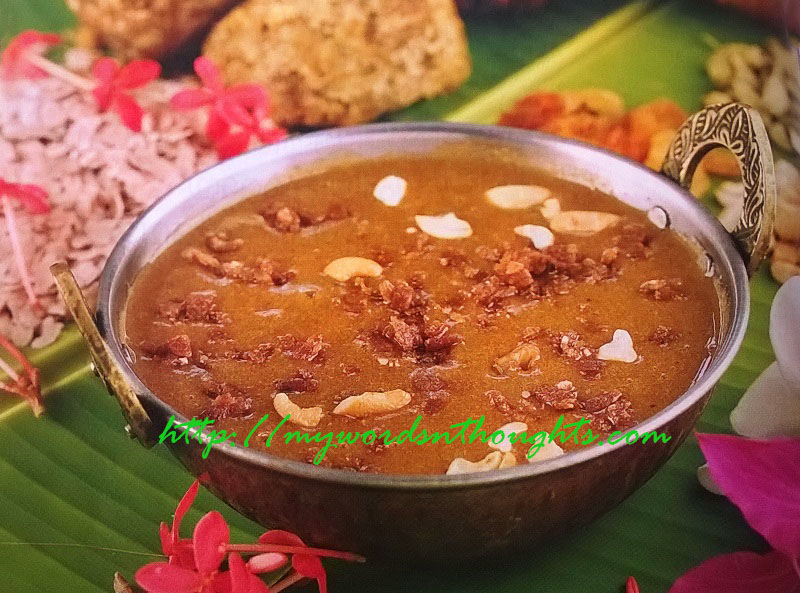
Suppose there are four payasams/pradhamans for a Kerala sadya—Ada Pradhamam, Paal Payasam, Kadala Parippu Pradhaman, and Palada. Which one should be served first? Ada Pradhamam is given the first place. So, ada pradhaman with jaggery is served first. Then comes Kadala Parippu or Cherupayar Parippu Pradhaman, followed by milk-added pradhamans. Jaggery-added payasams are always served first.
Nowadays, the days are gone when family members together entered the kitchen to prepare dishes for Onam and Vishu. Now everything, including sadyas and payasams, is readily available in the market. All you need to do is dial a number and order what you need. They can reduce your manual efforts so much. But they can never bring those glorious moments and nostalgic memories back once again!
So, what are you waiting for? Just enter your kitchen and make a payasam of your choice along with your family members. Cherish a few light moments with cracking jokes and chats, if you can.
Please read a few Payasam & Pradhaman recipes. Click on the images in the gallery to get the recipe.






Recent Comments