
Significance of Anyonyam held at Kadavallur Sree Ramaswamy Temple, Thrissur
In the monsoon winds of Mithuna month, just before the Ramayana month of Karkidakam begins, the ancient sounds of Vedic chants fill the air. At dusk, under the glory of the lighted lamps, the Sreerama Temple takes on a royal glow. This land follows a rare tradition of Rigveda chanting called Anyonyam. It is a place filled with stories, legends, history, and rich cultural heritage, where all of them are interlinked – Kadavallur of Thrissur district. Through the misty rain, you can see the lights being lit one by one in the Kacheri Maalika. Lamps are also lit at the sub-deity temples and the Koothambalam, beginning the first Deeparadhana (Evening prayers after sunset) in front of Lord Rama.
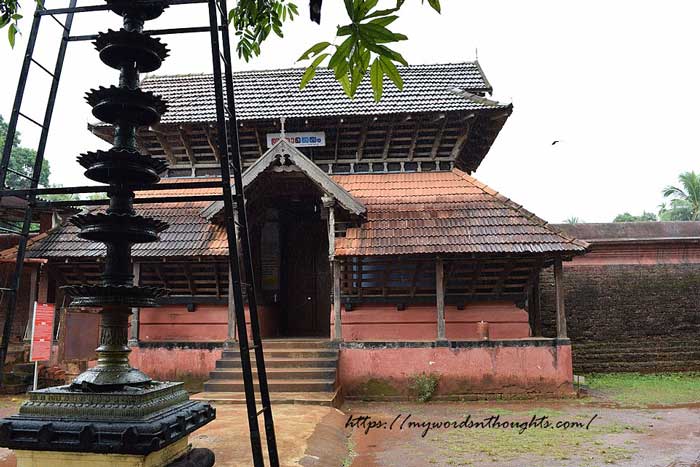
Lord Rama appears here in four different forms: The form in which he sets out for the forest exile for 14 years, the form showing anger towards Varuna, his royal form after the Pattabhishekam when he becomes king and finally, the Shankara-Narayana form, seen after midnight. When we walk around the temple, praying to Sreerama in his royal form, we understand the signs of ancient wisdom and the paths carved by time. Let’s know more about Kadavalloor Sree Rama Temple and its rare Vedic tradition of Anyonyam, for which this temple is famous.
Kodandapani Sreerama – The one who holds the Kodanda bow
The Kadavallur Sreeramaswamy Temple is famous for some of its unique features. Its ancient temple architecture and the completeness of its Tantric rituals need special mention. This ancient Rama temple is believed to be more than 800 years old. One of the special attractions here is the two-storey sanctum sanctorum (Sreekovil). Surrounding the Sreekovil, there are 29 ancient wooden sculptures, carved on wood. These carvings are truly amazing.
Among them, the scene of Sita’s abduction and the sculpture of a woman tying her hair look almost lifelike. In the Sita abduction scene, you can clearly feel Sita’s helplessness and Ravana’s anger. The craftsmanship of the sculptor who carved these expressions as if he watched it live, is truly worthy of admiration of everyone.
There are many references to Kadavallur in the ancient Hindu Puranas. In the Bhargava Purana, when someone asks which is the holiest place in the Bhargava temple, the answer given is Ghatolkachapuram. This is believed to be the original name of Kadavallur. The reason for this name is the belief that the unique Sreerama idol in the temple was installed by Ghatolkacha, son of Bhima from the Mahabharata.
According to legends, this temple carries the sacred presence of two yugas (eras). In ancient times, when King Dasharatha of Ayodhya was suffering because he had no children, Lord Mahavishnu gifted the sage Vasishta a four-armed idol (Chaturbahu). Vasishta later gave this idol to Dasharatha. Dasharatha worshipped this idol with great devotion and then performed the Putrakameshti Yaga, a ritual to be blessed with children.
As a divine blessing of the ritual, his four sons were born, as per Ramayana. Later, this four-armed idol was gifted by Lord Rama to Vibhishana, the righteous king of Lanka. In Lanka, Vibhishana worshipped this idol as a symbol of Lord Rama, after he was throned as the king.
During the end of the Treta Yuga and the beginning of the Dwapara Yuga, during the time of Yudhishthira’s Rajasuya sacrifice, Ghatotkacha, the son of Bhima, went to Lanka and took back this idol – as per legends. He then sought guidance from Sage Agastya, where the idol should be installed. On his journey, he saw Lord Subrahmanya (the commander of the Gods and son of Shiva) bathing in a beautiful lake. Sage Agastya instructed Ghatotkacha to install the idol on the north-west side of that lake.
At the northeast corner (Ishanakoṇa) of the installation spot, the sage created a sacred well using his yogic dhand, he carries with. He instructed that water from this well must always be used for the temple rituals, abhishekam and everything related to it.
As you walk listening to this beautiful legend, you see the powerful four-armed idol, Chaturbahu, which appears more like a living idol. It is nearly six feet tall, with ears that reach down to the shoulders. Because of its height, the deity’s face can be seen clearly from anywhere in the courtyard during the rituals. On special days, a special decoration called Golaka is done on the idol, and that is when its divine radiance becomes most visible. This temple is under the control of Cochin Devaswom Board, and Paramel Manakkal Rurar Namboothiripad is the Ooralan. Read: The different festival colours of Uthralikavu Pooram
The Story of the Elephant-Belly Wall (Aanapallam Mathil)
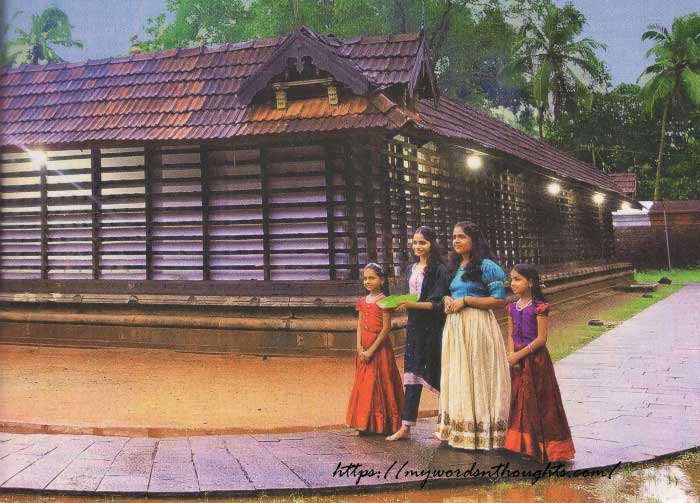
The compound wall around the temple has many special features. This ancient construction, which is budged is called the Aanappallam Wall. The middle portion of the wall is bulged outward, like the belly of an elephant. Because of this curved structure, snakes and other creatures cannot climb it easily.
The Kumara Saras, where Subrahmanya once bathed, now spreads over more than two acres. Its water is as pure as tears. During summer, people from the whole region come here to bathe. Even when it rains heavily, some still bathe in the pond — a habit they have kept since childhood. When you come out from there, you can see the beautiful sub-shrines. These are the sacred places where Ayyappan, Shasta, and Durga reside. Right next to them is the Devaswom office building.
The Kadavalloor Anyonya Parishad is another important facet of the Sreeramaswami Temple. The Parishad has compiled & published nearly 30 books containing the Vedic discourses presented during the Anyonyam. Since the Anyonyam begins only after the Athazha Pooja (night ritual), the cultural meetings, poetry sessions, and other programs are held during the daytime only.
This temple stands as a watchtower of ancient Indian Vedic knowledge which has amazed and still amazing the world. Even while society outside changes rapidly, the people here try to live in the old traditional ways, and they find peace in that. The enchanting sound of the ilathaalam (traditional metal cymbals included in Panchavadyam – the percussion of 5 instruments) that resonates across Kerala, originates from Kadavalloor. The ilathaalams that bring waves of joy to festival grounds are forged in the furnace of Kadavalloor. Only the Kammala craftsmen, who once migrated from Tamil Nadu, still possess the secret of making them. It can take up to 30 years to fully master the skill of melting and preparing the metal for an ilathaalam. Isn’t their hard work worth mentioning?
What is Kadavalloor Anyonyam?
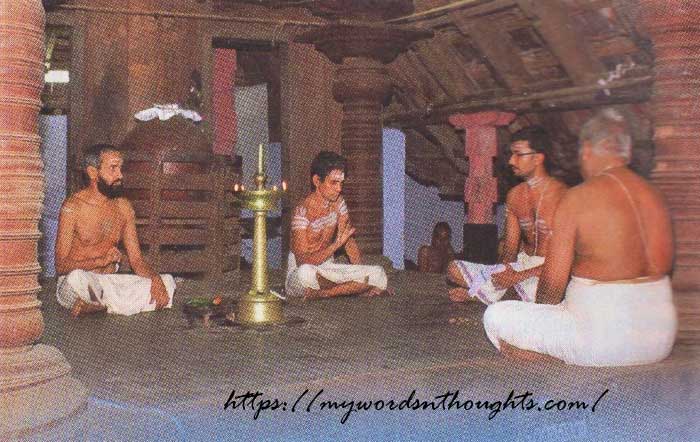
Kadavalloor Anyonyam is the historically famous Vedic oral examination held at the Kadavalloor Sreeramaswami Temple. It is a very rare and unique exam conducted for preserving the Rigveda, which is considered the foremost of the Vedas.
There is no writing in this exam — it is entirely based on chanting from memory. Anyonyam is held for eight days from the first day of the Malayalam month of Vrischikam, excluding Ekadashi (11th day) and Vavu (new moon), which are fasting days.
To participate in Kadavalloor Anyonyam, one has to pass a qualification test. It’s not so easy and needs a lot of hard work, dedication and knowledge. The student must recite the Veda with excellence at different temples during their weekly ritual sessions. After that, only those who pass the examination called “Keezhakku- Padinjare” held at the Thrissur Devaswom Math can enter the Kadavalloor Anyonyam.
The event begins with a ritual called Vedajnana Varana (invocation of Vedic wisdom). Scholars from Thrissur and Tirunavaya (belonging to two traditional Brahmaswam institutions) participate in two separate groups. On the 30th day of the Malayalam month of Thulam, the members of both Brahmaswam groups have their first meeting at the entrance of the Kadavalloor Temple and then separate. After that, even if there are relatives or friends in the opposite group, they are not allowed to talk or interact until the exam period is over. They have to act as total strangers, even if they know each other. That tradition is strictly followed.
The exam is conducted in stages called Vaaramirikkuka, Jata Cholluka, and Ratha Cholluka. More than 14,000 mantras are present in the Rigveda – the oldest Veda, which is divided into eight Ashtakas. Selected mantras are used for the examination. On the first day, one group begins by chanting mantras from the first Ashtaka and challenges the other group. On the second day, the exam is repeated, but the groups switch roles. Inside the temple compound, on the southern side of the Koothambalam, two scholars from each side sit facing each other and participate in the contest.
For those who successfully complete these tests, there is a higher level of examination called Kadannirikkal and Valiya Kadannirikkal. These two are considered extremely prestigious positions in the Vedic community. In the Anyonyam, the Rig Veda chants are recited in a special rhythmic pattern.
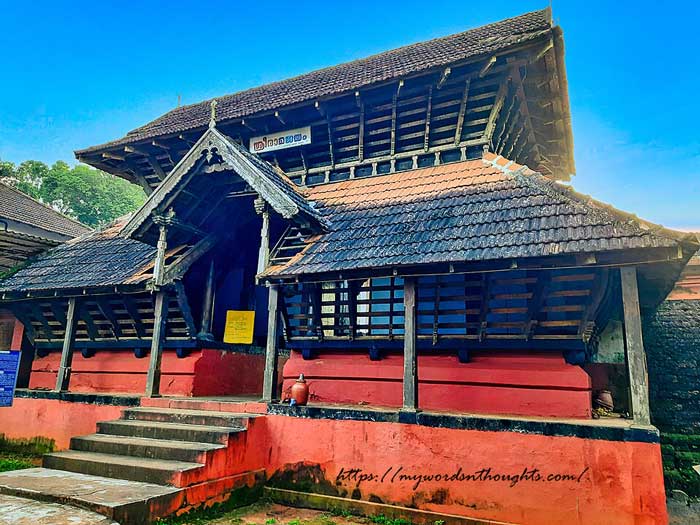
For centuries, Anyonyam was conducted without a break. But in 1947, due to some unexpected reasons, it stopped. It was restarted only after a long gap of 42 years! Realising the historical importance of Anyonyam, the Devaswom officer of that time, Gopinathan Korambath, revived it with the support of the local people and the Devaswom. Now, for more than three decades, Anyonyam has been conducted in an expanded and grand manner. Even big containers are used for storing and serving food for those attending the celebrations.
The method of studying the Rig Veda in Kerala is very different from many other Rig Vedic schools in India. In Kerala’s Vedic tradition, chanting is done with special features — moving the head, showing hand gestures, without missing even a single syllable and without any mistake in meaning. This is a unique feature found only in Kerala. It is believed that, centuries ago, Anyonyam used to be held in many places. Because Thrissur and Thirunavaya mutts lie in between, Anyonyam eventually came to be held at the Kadavallur Sree Rama Temple. In present times, this temple is gaining popularity for hosting this Vedic tradition and recitals.
Anyonyam takes place at the mandapam built next to the sanctum sanctorum (Sreekovil). The Vedic examinations happen at night. During the daytime, seminars and discussions are held outside the Aniyonyam mandapam. Though so many years have passed since Aniyonyam restarted, only one person has ever passed the “Kadannirikkal” (advanced level) examination — Dr. Jathaveda Namboothiri of Mannoormana, Karumathazhi, near Valancheri in Malappuram district. He is a well-known psychiatrist in Kerala.
The essence of the Vedic mantras is the well-being of all beings. Kerala’s cultural world has recognised the importance of Kadavallur Anyonyam in preserving the Vedas and the Vedic learning tradition. After the Athazha Pooja (night offering), the lamps in the Kacherimallika building were slowly being put out one by one. Behind us we can hear the ancient sound of the temple doors closing. Through the breeze, the timeless notes of the Vedic chants continued to float:
“Om Agnim īḷe purohitam
Yajñasya devam ṛtvijam…”



Recent Comments