
Incredible Forms of Kerala’s Koothu – An art that connects with the audience
Nowadays Koothu is performed in school and college competitions, where young kids and college students are seen performing this art. When most of traditional art forms are seen disappearing from scene, it’s a heartwarming experience to watch this art form, even as a sort of competition item. Needless to say, similar to Ottanthullal, Koothu is one of the most entertaining art forms of Kerala, where performers interact with audience, that too in a humorous way. This entertaining art form, which combines both stories and songs and performers’ lively performance is gaining popularity in recent times. The way by which the performer connects with audience and keep everyone fully engaged and entertained, and the artist’s screen presence make it popular among the crowds. An art form that connects with the audience, let’s drive deep into the history of Kerala’s Koothu.
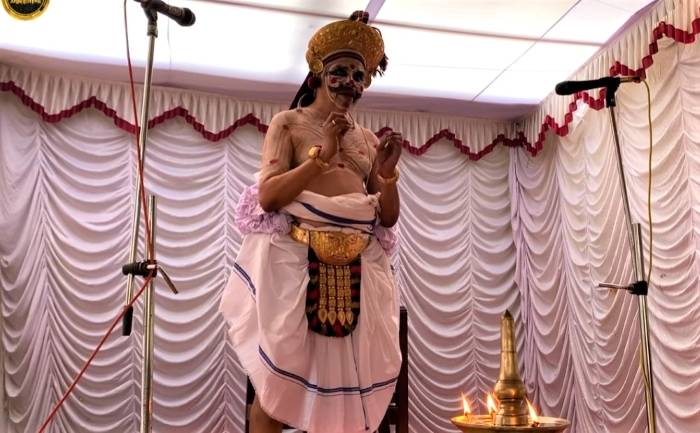
Chakyar performing the Koothu
Kerala’s Koothu – A traditional art form of Kerala performed in Koothambalam
In a single phase, Koothambalam is a traditional temple theatre found in Kerala. Koothambalam is a part of many temples, where Kerala’s performing art forms associated with Hinduism are presented in front of the crowd. Artists appear in traditional costume and makeup, and perform there. Mostly Koothu, its related art forms such as Koodiyattam and variants such as Chakyarkoothu and Nangyarkoothu are performed here.
The word ‘Koothambalam’ itself comes from Koothu. ‘Ambalam’ means ‘Temple’ in Malayalam. So, Koothambalam is the temple or home of Koothu. It’s also referred to as Naatya graham – a home of performing acts. They are constructed according to certain rules, as specified in Natya Shastra, and they have a specific architecture and construction model. Such Koothambalams are most common in Kerala.
The word is derived from a Sanskrit word ‘Koorda’
Koorda means Kreeda or Play, and Koothu is an entertaining art form. That’s how the name is derived. In Kerala, it is broadly divided into two – Chakyarkoothu and Tholpaavakoothu, and it’s not the same as Tamil Nadu’s Koothu, or Therukoothu, which is also a story telling performing art form. Though Therukoothu derives stories from Hindu epics, they mostly adapt Tamil epics like Silappatikaram, combining with mythology and folklore. Kerala’s art form uses Sanskrit and Malayalam for performance and conversation with audience. But still, it has a Tamil connection, similar to many ancient forms.
Chakyarkoothu is the dramatical representation of Sanskrit, where fun, comedy and entertainment become the prime elements, while Tholpaavakoothu is the stage performance of Tamil drama where Kamba Ramayana – Tamil Ramayana is used to express themselves. Also read about different written versions of Ramayana. It’s performed mainly in Bhadrakali temples, especially in Palakkad and Thrissur districts. In Tamil Nadu, it’s mostly performed in Kanya Kumari, the bordering district of Kerala. Nizhalkoothu is another variant, where shadows perform on stage.
Puppets are the actors in Tholpaavakoothu
In Kerala, Tholpaavakoothu is a temple ritual performed outside the temple. The arrangements are done in Koothu madam. This practice began during the era of caste discrimination when lower caste people, known as Avarnar were not allowed inside the temple, and Tholpaavakoothu was solely aimed for their entertainment purposes. Every Tholpavakoothu is a Nizhalkoothu, but not necessary vice versa. This ritualistic shadow puppet theatre of Kerala uses puppets made from cured deer skin or goat skin, and cut into intricate figures. Only natural dyes are used to paint them attractive.
A white cloth screen, locally called Aayiram thiri is first displayed and these puppets are placed behind, facing the audience. Then oil lamps are lighted behind Aayiram thiri, creating shadows on the screen. Tholpaavakoothu can last for 7, 14, 21 or even 41 days during temple festivals, based on different factors. Traditionally it’s performed by Pulavar artists, a community in Kerala. They recite verses from Ramayana, especially the Kamba Ramayanam (Tamil version), and manipulate the puppets rhythmically using hands, along with music and narration.
Chakyarkoothu is the real entertainer
Chakyars are seen as the representatives of Soothan who tells Hindu mythological stories in the kingdom of Saunakami. During early days, it was exclusively conducted in temples, performed by members of the Chakyar caste, a subcaste of Kerala Brahmins. Now it’s widely performed on stage as well as school and college competitions, irrespective of the caste group the artist belongs to.
This monodrama tradition of performance has distinct two parts – drama acting and story prediction. Drama acting was earlier known as Kooth. When an artist singly performs, it’s called so, while it becomes Koodiyattam, when performed as a group. Now it’s normally used in story prediction and storytelling. Both these art forms are traditionally performed by Chakyars, hence the name. While Chakyarkoothu is performed by male artists, Nangyarkoothu is a related solo dance form performed by their female counterparts, the Nangiars. Hence the name. Similar to Koodiyattam, artists are dressed in female attire and it follows the performance text named Attaprakaram.
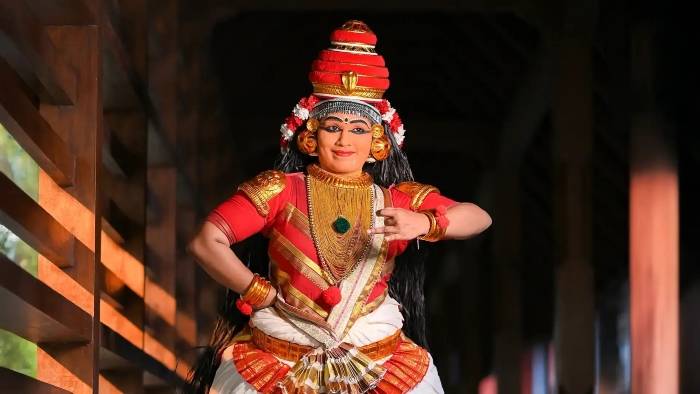
Nangyarkoothu performed by a female artist
When it’s ritualistically performed inside temples, only Chakyars and Nangiars perform it. When it’s performed elsewhere, other communities may also participate without any restrictions. It was the great artist Guru Mani Madhava Chakyar, who took Chakyarkoothu outside temples to public stages and academic institutions. When performed outside, the artist may talk about current affairs, problems of common man etc.
Chakyar, who always play a solo act, performs in the costume of Vidooshaka. He uses rice flour to draw lines across his chest, hands and face. As per rules, he put red spots on 14 parts of his body including nose and cheeks. He draws his eyes using thick kohl to make his appearance more attractive. There are a few more accessories which perfectly fit into the appearance of Vidooshaka, and his aim is to entertain people, make them laugh and even mock them. Among Navarasas, Hasya rasa dominates all, and he even interact with audience to engage them better.
Mizhav and kuzhithaalam are the major instruments used
Among all the instruments used – mizhav, kuzhithaalam, idakka, kuzhal and shankh, mizhav is most important. Mizhav is a brass pot and its mouth is covered by a skin. Traditionally artists belong to Nambiar caste use Mizhav for Chakyarkoothu. While Chakyar performs on stage, Nambiars use their hands to beat mizhav. On its right side, a group of Nangyars sit on a cloth and use the instrument kuzhithaalam. Chakyar performs in front of a big lighted lamp. Only a stool is placed in the stage, and it’s for the performing Chakyar if he wants to sit for a while. Some symbols of prosperity, completely related to Kerala culture are also placed in front of the lamp before the performance starts.
The performance begins with Mizhav artist, who plays the instrument. The artist starts with ‘chaari’ – a type of dance followed by vidooshika strothram. He prays to the deity followed by peetika. Then the performer should praise the audience, gurus and elders, and pray for them. ‘Rakhsha Purushan’ is determined in accordance to the story selected for the play.
After Upakramam – the introduction of the performance, the performer proceeds to Purappadu (actual entry) and then Nirvahanam. actor enters the story telling. After the introduction, it’s the explanation of the situation. Chakyar briefly outlines the upcoming story or scene. This is known as ‘Samkshepam’ and slokas are recited one after the other. The processes from ‘Mizhavu Ochapeduthal’ to ‘Samkshepam’ are collectively known as ‘Poorva Rangam’ or the beginning of the act. The performance proceeds to acting, satire, and commentary, which form the main part of the act. For storytelling, Sanskrit Slokas are used, and Chakyar also gives its explanation in Malayalam, which is the most important part of the play. They use four types of acts – vaachikam, aangikam, saathvikam and aahaaryam.
Chakyar is keen in keeping audience engaged and awaked throughout his performance. In case if he notices anyone in the crowd talking, a bit annoyed or even sleeping, he calls them and even mocks them giving good entertainment to the audience. He always does it with a bit of humour. When the Chakyarkoothu is traditionally performed in temples, each part solely belongs to each community. While Chakyars perform on stage, Nambiars use instruments and Nangyars sing.
Their performances hide some dangers also
Some of their acts are risky too. They may use strange equipment and are rarely seen jumping from heights, floating and some blood bathes too. In Parakkumkooth (flying kooth), Chakyar disguised as Garuda, need to fly from top and reach the ground. He is doing this act with the help of strings and even move each and every body part, and is very risky many times. A simple mistake can invite life threat to the artist and can even cause him injuries.
When Koothu is performed as a group, it becomes Koodiyattam
The name itself suggests what it really means. It’s performed in temples by a group of Chakyars. Since it’s performed by a group, it’s known as Koodiyattam. Passed over through different generations, terms have been used interchangeable. Nowadays story recital of Chakyar is known as Kooth and their theatrical performance as a group is known as Koodiyattam.
There is a connection between Koothu and Thullal

Ottanthullal Performance
There is an interesting story connecting Chakyarkoothu and Ottanthullal. Ottanthullal, a form of Thullal was first performed by Kunjan Nambiar, a mizhav artist. This incident occurred in Ambalappuzha Krishna Temple is an integral part of Kerala culture, art and history.
While his guru was performing Chakyar kooth in a temple, Kunjan Nambiar was among the group of Nambiars who used Mizavu instrument. But Kunjan slept during the act, though it was purely unintentional. But his guru humiliated him in the open stage in front of others, and Kunjan really felt bad for it. Deeply hurt Kunjan performed another art form in the same temple while Nambiar was giving his performance, and to great surprise crowd started accumulating here, leaving behind Nambiar’s performance. Kunjan Nambiar was performing a rigorous dance form with unique costumes and he called it Ottanthullal. He also formulated two more derivatives of Thullal – Parayan Thullal and Sheethangan Thullal. But still, because of the catchy and humourous lines, Ottanthullal gained more popularity than Koothu and other forms of Thullal.



Recent Comments