
Do you know about Shrinathji Temple of Nathdwara, where Lord Krishna is worshipped in the form of a seven-year-old child on Janmashtami day? It’s believed that Krishna self-manifested from a stone and emerged from the Govardhan Hills. The temple is designed in the lines of Nanda Gopal (Krishna’s foster-father) temple, in Vrindavan.
Nathdwara is not a big city. As you travel from Udaipur through the winding roads of the Aravalli ranges, you begin to feel a change in the atmosphere. The gentle sound of temple bells, the fragrance of fresh flowers, and the devotional ambience fill the air. Bhakti and peace fill the space.
Here, Krishna is worshipped as Shrinathji. The rhythm and daily life of the town moves according to the eight daily darshans of Shrinathji. The streets leading to Shrinathji Temple are narrow and crowded. You can see vendors selling yellow garlands, shops filled with beautiful paintings, and pilgrims singing bhajans hurriedly rushing for the next darshan.
Do you know the legend behind Shrinathji Temple, Nathdwara?
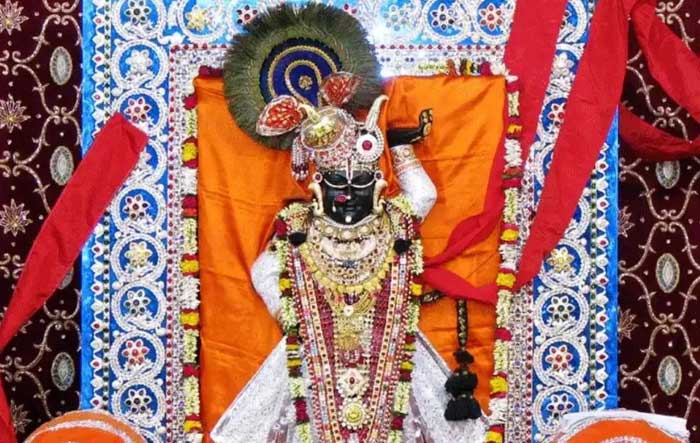
There is a story behind the Shrinathji Temple. When Mughal Emperor Aurangzeb attempted to destroy Hindu temples, the idol of Shrinathji was taken from Govardhan in Vrindavan to Rajasthan for safety.
Maharana Raj Singh of Mewar gave refuge to the deity. When the chariot carrying the idol reached a place called Sihad (Sinhad), its wheels got stuck in mud and could not move forward. Believing this to be divine will, Maharana Raj Singh decided to build a temple there and consecrated Shrinathji at that spot. Lord Shri Krishna protects the Braj residents and the cows of Braj.
The place once known as Sihad came to be called Nathdwara (Nath – Lord, Dwara – Gateway)
This is the main seat of the Pushtimargiya Vaishnava tradition. The black stone idol of Shrinathji is believed to have been consecrated here in 1669. Shrinathji is worshipped in the form of seven-year-old Krishna. The deity is depicted holding up the Govardhan mountain with his left hand, while the right-hand rests on his waist. The slightly tilted posture adds a unique charm to little Krishna.
Unlike most Krishna images, Shrinathji is not shown playing the flute. Instead, he stands in the pose of lifting Govardhan. There is a precious ornament on the chin of the black stone idol. According to legend, this ornament was gifted by Aurangzeb.
The story goes like this:
Once, when Aurangzeb arrived to attack the temple, he lost his eyesight the moment when he climbed the temple steps. Realizing his mistake, he prayed for forgiveness. His sight returned thereafter. When his mother heard about this miracle, she offered a vrajam (ornament) for the embellishment of the idol. It is this ornament that adorns the chin of Shrinathji today.
Shrinathji’s residence resembles a royal palace. Devotional practices here are unique—not only rituals, but the way the deity is cared for, as if he were a playful child in the household. Yes, the presiding deity is a 7-year-old kid. Each darshan represents a moment in little Krishna’s daily routine—waking up, bathing, eating, playing, and resting.
During the afternoon Rajbhog darshan, the offerings appear like a grand royal feast. There are temples of sub-deities Madan Mohanji and Navneet Priyaji within the main complex of Shrinathji Temple.
Kullad Tea and the Pichwai Lanes
Outside the Shrinathji Temple lies a narrow network of lanes filled with artists who paint traditional Pichwai artworks. Their brushes bring to life graceful cows, lotus flowers, and divine motifs on canvas.
Nearby, a tea vendor serves steaming masala tea in a kullad (earthen cup). The rich, spicy tea absorbs a faint earthy aroma from the clay, giving it a distinct flavor.
Every corner of Nathdwara is full of experiences—the sweet fragrance of fresh milk sweets, children running with laddu prasad, devotees slowly making their way through the narrow streets and cows walking leisurely along the streets.
A town where the festival-like vibrancy never fades
Nathdwara is full of divine moments woven together with legends and deep-rooted beliefs. More than a pilgrimage, it becomes an experience of devotion blended with art, food, and the warmth of people—a memory that remains in the heart forever.
The best time to visit Nathdwara and Shrinathji Temple is from October to March. It is just an hour’s drive from Udaipur. Photography is restricted inside the temple. So, you can capture those moments with your eyes and heart. Janmashtami, Holi, and Diwali are special occasions to visit. Aartis and the Shringar, where the deity is decorated are the major attractions.
Also, don’t leave without tasting the pedha prasad and the kullad chai. Their flavours will stay with you long after your trip.
Travel Information for Shrinathji Temple
Nearest Airport: Maharana Pratap Airport, Udaipur – approximately 60 km away.
Nearest Railway Stations: Mavli Junction (35 km) and Udaipur Railway Station (45 km).
Location: Nathdwara lies on NH 58.
You can reach Nathdwara and Shrinathji Temple by bus or cab from:
Udaipur – 40 km
Mount Abu – 185 km
Ahmedabad – 300 km
Jaipur – 350 km
Also read: A brief note on Ottoor Sree Krishna Swamy Temple near Varkala








Recent Comments