
Mollywood has evolved a lot from 1960s to 2020s. New styles of filmmaking have come into existence. It’s all about changing times and demands. Many scenes of even movies of 1990s and 2000s which we loved that time may appeared weird and senseless when we rewatch them. In short there is no strict rule in filmmaking. Certain films may cater certain type of audience. Yet some films really stood against the test of time. Through this column, let us briefly discuss the evolution of Malayalam cinema over the decades.
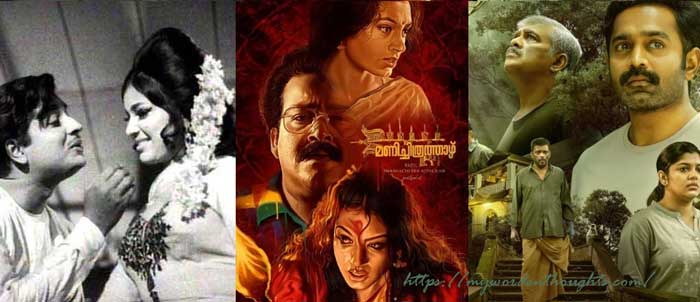
Women were objectified in the early classic era
Mid-1980s till late 1990s – The golden era of Malayalam cinema. Before that, women were mostly objectified in films, especially the 1970s when some scenes were intentionally added. Though films act as mirror of the prevailing culture of the respective times, many times, when we look back, we feel like those scenes could have been avoided. You can pick cinema of any decade, what presented on big screen was what public demanded. May be many scenes reflected the society back then.
Bath scenes of heroines and rape scenes were normalized those days. You will find bath scenes of heroines in almost every movie from 1960s to early 1980s. Many heroines were minors those times. During present times such scenes will never be shot on Malayalam screen, unless situation demands.
There was one actor (am not taking his name) similar to Prem Chopra of Bollywood 1970s and there will be some scenes forcefully added in each and every film he acted. Powerful women-centric films the with actresses like Sheela and Sharada. Yet a good percentage of 1960s and 1970s films exist, which we can’t watch them entirely with family now. Even some romantic songs were written that way, though poetically beautiful and classic, especially those solo male songs describing heroines. But Bollywood lyrics of classic era were so pure.
Comedy and family entertainers begin in the decade of 1980s
With beginning of 1980s, there came a bunch of new young directors, Fasil, Priyadarshan, Sathyan Anthikad, Sidhique-Lal, Kamal etc who made comedy and family entertainers, which we can watch with whole family. They were rewatch value too, and even youth of present generation watch them. Parallelly there were masala entertainers too, with ensemble cast. They were box office hits too. But present-day kids rarely watch them.
There were some serious & extremely talented filmmakers like Bharathan, I V Sasi and Padmarajan who made bold films in 1980s, but with 1990s a slow shift happened towards family films. It was the demand of time. Padmarajan passed away in 1991. Yet in the beginning of 1980s, beginners like Mammooty and Mohanlal did many B-grade films, and some movie scenes when we see now, we wonder how they accepted such roles. But with mid-1980s, a bunch of young directors did some classic films. Most of Priyadarshan Hindi remakes belong to this era. Songs were also too good. Sreenivasan wrote some brilliant scripts of the era, he directed a few and he acted aside Mohanlal in countless films. Mohanlal’s combo was amazing with Jagathy Sreekumar too. We had a huge line-up of talented character artists like Nedumudi Venu, Thilakan, Oduvil Unnikrishnan, Kaviyoor Ponnamma etc.
A great shift happened to Malayalam cinema with early 2000s, downgrading it
Around late-1990s, Mohanlal’s mass entertainers like Aaram Thampuran and Narasimham became blockbusters, but his classic films like Devadoothan failed at box office. Mohanlal’s Ravana Prabhu became a blockbuster in the early 2000s. Then came the demand of such mass masala entertainers, where writing was not at all needed. Heavy and mass dialogues were written and well-executed. All action films fell under same template.
Mammootty & Suresh Gopi – The big superstars also started doing such kind of films. Other actors followed the same. No one was willing to do some kind of experiments with creativity. Also B-grade movies of Shakeela and others dominated box office with beginning of 2000s. That was the downfall of Malayalam cinema. After Manju Warrier took a break from industry following her marriage, no other heroine could take her position. In the 4-5 years when she was active in the industry from 1995, she gave some masterclass performances. To add, many films of 1990s and early 2000s are so misogynistic when we watch now. But with changing times, as mentioned before, Malayalam cinema has accepted the changing society.
Some kind of relief through Dileep starrers from early 2000s
Even during those bad times, the romantic films of Kunchakko Boban, heartthrob back then, and Dileep’s comedy entertainers gave some kind of relief. Dileep managed to bring audience to theatres and somehow compensated the bad times. Prithviraj also occasionally gave some good movies. Most movies of 2000s had more or less same storyline (with some exceptions), now those movies will never be listed in best Malayalam films – either in making or performance-wise. Comedies of Suraj Venjaramoodu and Salim Kumar also ruled hearts.
Major Ravi gave some memorable movies based on Indian Army and Blessy gave some memorable emotional dramas. Directors of 1980s who started the revolution also started losing their Midas touch and charm. Also, they made less films. Innovative writing & good comedies became dead. Sreenivasan’s comedy was dead, and his glorious years gone. Jagathy Sreekumar met with an accident and he went into coma in early 2010s. His movies of 2000s were not good either, because films made that time were not good. His peak time was during the first half of 1990s, when he did great movies with Mohanlal.
2010s and New wave cinema in Mollywood with nepokids
Then came 2010s – the generation of Fahadh Fasil and Vineeth Sreenivasan, followed by Nivin Pauly and DQ. Comedians like Aju Varghese and actresses like Nazriya Nazim & Parvathy gave memorable performances. Prithviraj’s performances became mature. They gave a new face to Malayalam cinema. With early 2010s, some new generation directors with new style film making entered arena and slowly, Malayalam returned back to its glorious era. Apart from talented new gen actors including supporting cast, Mollywood has talented writers, cinematographers and strong technicians. They are working in other industries too. That’s the evolution of Malayalam cinema.
OTT bloom for Malayalam cinema after 2020 pandemic
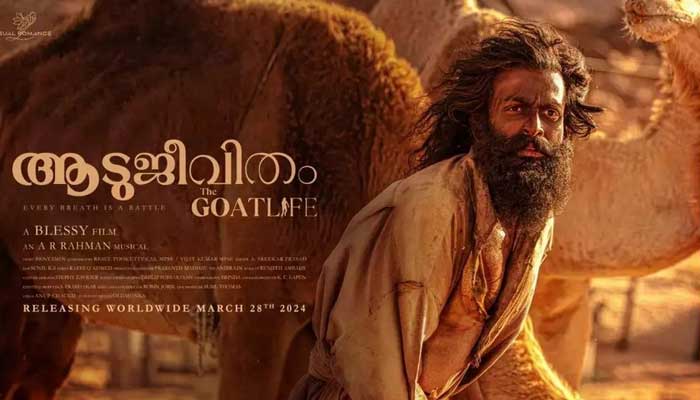
As Malayalam’s audience is only a small population, budget has its own limitations. But the exhibition of talents knows no boundaries. That’s why creativity and screen writing are given much importance in Malayalam cinema, comparing other industries. Here quality is given first preference and post-pandemic, Mollywood is widely accepted across India. It now reaches a wider audience, and most stars & technicians are recognized by people belonging to other regions too.
Now Malayalam films have proper Hindi-dubbed release and almost all films are dubbed across different languages for OTT release. Malayalam films are gaining immense popularity & even country’s leading filmmakers and vloggers discuss about new Malayalam releases, which was not a happening before 2020. Only remakes of Malayalam were possible those days. Now cinephiles are willing to watch the Malayalam films in original language with subtitles at theatres. That’s the huge evolution of Malayalam cinema over the years.
To add, while a lot of debates are going on about how nepotism harms cinema of present times, nepokids of Malayalam are being praised. There is a huge row of nepokids in Mollywood right now, who succeeded only because of their talent, and most of them are receiving Pan-India appeal too. Dulquer Salman and Prithviraj are doing multi-language films including Bollywood and Telugu.
Also read: Mollywood is not free of superstitions and beliefs








Recent Comments